Tuesday, May 24, 2011

In the Garden with Flea Beetles

I was just rounding out hour number five of transplanting onions in the garden, when a rain storm blew over the hill and soaked me through. Now that I am in dry clothes with a cup of tea, the sun is back on the scene. Oh well.

We have been dealing with flea beetles. If you are unfamiliar with them, they are black with a reflective, almost metallic looking shell. They eat small holes through the leaves of a specific group of plants, mostly radishes, kale, arugula, and things in the kohl family. If you were to see one and reach out to squish it, you'd probably fail, because it would have rocketed into the air and onto the next leaf by the time your hand received your brain's impulse. They thrive on the plantain in our pastures, so I have no hope of actually diminishing them on any scale, but I would like to control their activity in our garden. We read about two organic options: 1) Spray the plants with a strong solution of cayenne pepper, which would protect the plants by making them undesirable, but not reduce the pest's numbers. 2) Buy yellow fly traps. Flea beetles are supposedly attracted to the color, and after landing there they get stuck to the adhesive layer and die. I didn't love the idea of spending money on something I could make with a few random things we have here, and Garth found confirmation online that people have had some success making their own. Here is my version. It kind of works.


I chose a few pieces of glass, and rummaged through a pile of old oil paints- strange ones I had to buy in art school and haven't used since. I found a windsor yellow and painted it onto one side of the glass. I initially intended to let it dry, but the flea beetles were getting ahead of us, so I shortened the timeline by smushing one half of a plastic bag over the wet paint. I trimmed the plastic and took it up to the garden where I poured some mineral oil over it. If you put too little oil on the glass, the flea beetles will hop on and hop right off. If you put on too much oil, it runs over the edges and onto your garden. But if the amount of oil is just right, the flea beetles leap on and won't leave. I think this trap has lots of room to evolve, but it is doing something. There are still a lot of them eating our plants, but at least I feel like I have a hand in the game as it plays out.


And on a final note, we had the first fruits of the garden this year- a salad made with thinnings from our rows of kale, lettuces, and arugula. Although we enjoyed the dandelion greens I harvested from the fields throughout April, there is something to be said for the tenderness of cultivated plants.


- Alanna

Sunday, May 15, 2011

On Ramps


My interest in farming and food production, though longstanding, has been abstract for most of my life. Apart from butchering an occasional deer, my teenaged ideas about food were formed at some degree of removal from the source of what I actually ate. I became largely vegetarian in an attempt to minimize my environmental impact and to minimize my support of factory farms. The venison was okay to my mind, because I knew there was an excessively large population in my suburban area, and - apart from cars - human hunters were their only predators. In college and after it I tried to shop at farmers' market. I read Michael Pollen.

Moving to the farm has made my thinking about these topics far more serious, which is to say, far more specific. Organic practices are easy to endorse in principle, but as I look at a bed of cabbages in which every seedling has been killed by flea beetles, it is easy to imagine what a godsend effective pesticides must have seemed, and must still seem, to many market growers. I am now an emphatic omnivore, not only because I have come to believe that a high fat, relatively high protein diet is probably ideal for humans, but also because most farms in our area, and our farm in particular, is much better suited to growing animals on grass than anything else.


As these smaller questions have been both complicated and clarified, the larger question of agriculture has come into focus. The alternative agriculture publications I read, such as Acres, Graze, and The Stockman Grass Farmer, implicitly acknowledge what books like The Botany of Desire and Against the Grain explicitly state - that agriculture is a process of coevolution rather than human control. The latter of these two books, which I found interesting, though frustratingly cursory, posits that the ancestors of the annual crops that either directly, or as livestock feed, provide the vast majority of human food evolved to take advantage of the brief niches left in the wake of a huge environmental upheaval, such as a fire or a flood,. Because of this, the partnership we have created with them requires us to continuously simulate these conditions. We keep huge swaths of land bare and fertilized for them, they provide food for us. The result is erosion, soil mineral depletion, famine and for most civilizations throughout history eventual collapse.

Though our entire world rests on the supposition that the dynamic of bare land and monocultures can be maintained over the long term, that continued scientific advances can keep yields permanently high, I am skeptical. Whether phosphorus depletion, topsoil loss, or energy scarcity, the maximum yield for the arable land on the planet will be reached, and then decline. This is one reason cows strike me as better than corn, at least in the long term; though lower yielding in a single year, an agriculture of cows on grass, perhaps followed by chickens, sheep and pigs, is closer to the sort of stable ecological systems that cover the parts of the planet not recently touched by flood or fire or humans.

Which brings me to ramps. Ramps, also known as wild leeks, grow in dense bunches on the floor of deciduous forests. They have broad, droopy leaves growing up from slim bases, and their flavor is complex and earthy, like an onion crossed with a mushroom. We bought several bunches at the market last year, and this spring we hoped to buy them with dirt still attached so that we could establish a patch in our woods. But a month ago Alanna and I were out walking the fence line, and on the steep, wooded bank above the pasture we saw a swath of emerald amid the dormant trunks. I hopped the fence and picked a few just to make sure, and as we continued, we sighted more and more patches.


Ramps are beautifully adapted to their niche. They do not compete by aggressive growth or setting huge amounts of seed or exuding chemicals from their roots to poison neighboring plants. In fact, they don't seem to compete much at all. Instead, in the month or so before the trees have begun to leaf out, the ramps grow their tops and take advantage of the available sunlight. When they are shaded out their leaves die back, and they send up flowers and set seed. But because they harvest all their energy in so brief a window, with such marginal temperatures and light, they are slow to grow and to spread, whether by seed or by splitting off a new bulblet. The most reliable source I could find suggests that they take five to six years to reach maturity, at which point they are about the same size as a scallion. This same source suggested that for a patch to have a stable population only 5-15% can be harvested annually. Given this extended time frame, ramps would seem to be poor candidates for domestication, so I am guessing that the burgeoning interest in wild edibles will likely see them eradicated from much of their native habitat.

It is incredibly difficult for me to have the patience and perspective to limit myself, a fault I suspect much of humanity shares with me. I hope that I can be wise enough to harvest the small bounty of the rocky slope above our pasture in a way that does not diminish it. But the idea of imposing to a greater or lesser extent a set of animals and plants on a place, and hoping that they can be nudged into some sort of stable relationship while simultaneously providing human food feels sometimes foolishly optimistic, sometimes insane. From hunting megafauna to extinction to tilling the prairie, human intervention in North America (or anywhere else, for that matter) has not generally led to increased ecological stability.

When I think of the tiny bulbs sleeping ten months of the year in the shale and duff, unfurling lush leaves for a brief moment, incrementally building their reserves like interest in a bank account until they can split off an offspring or send up a shoot, I am encouraged and disheartened. I am encouraged that I can understand the cycle and try to live within limits that will not compromise it. I am disheartened at the thought this understanding prompts of larger cycles that I don't understand or choose to ignore for fear of the limits they would imply.

-Garth


Friday, April 29, 2011

Legacy


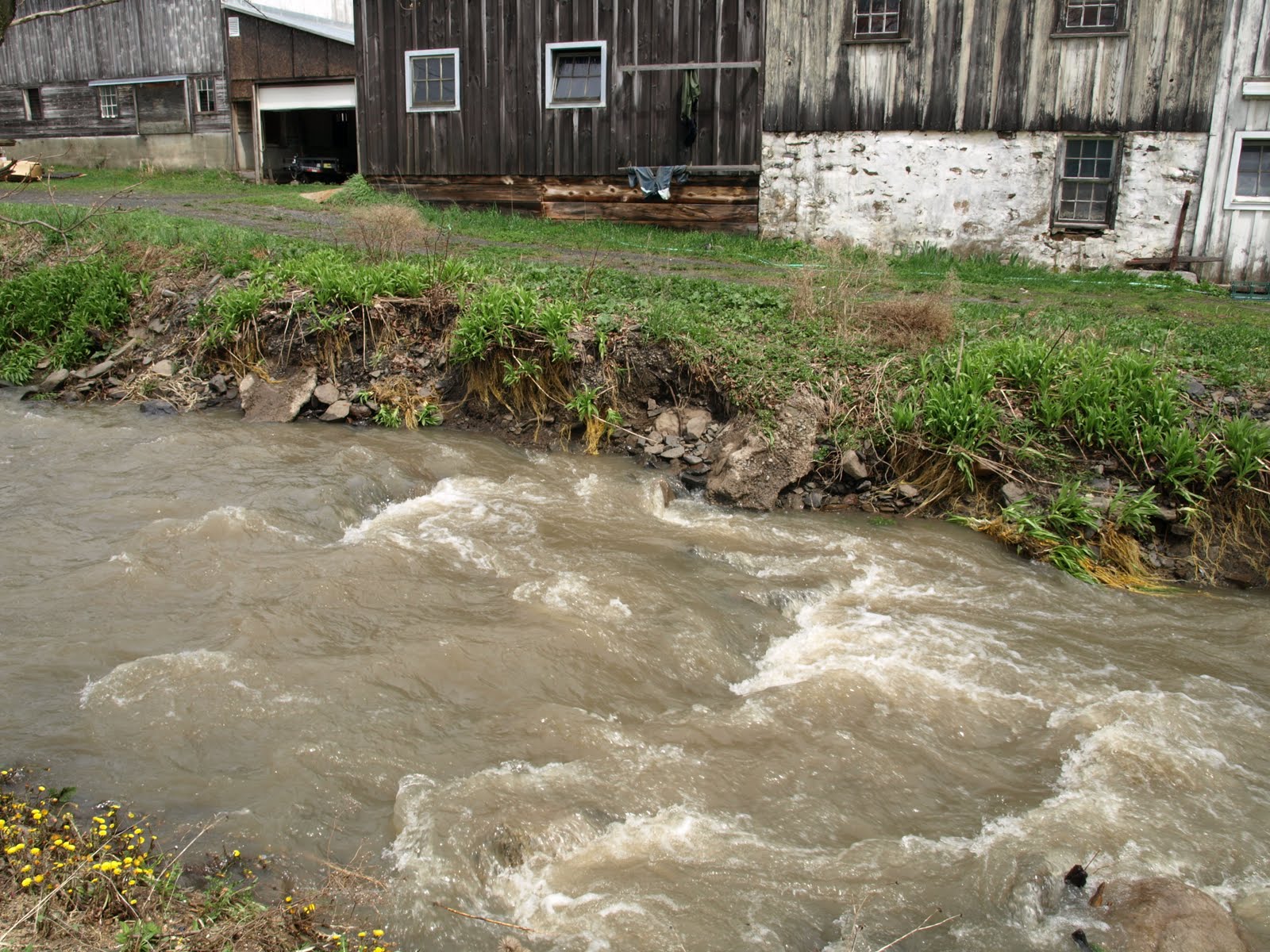
We've had a very wet spring so far this year. It has rained every day but one since April 17th, and the last few nights have been torrential in their output. The night before last night took the cake though. The legacy of flooding rain is writ large up and down our stream, from the falls all the way down to the big culvert just below our property line where Talbot creek crosses under Talbot road.


The farm was logged selectively in 2008 by men with big powerful machines who operated in a hurry without regard for the state of affairs when they left. In the gorge on the way back to the waterfall they dropped several large hemlock tops into the waterway. Last year our neighbor Don counseled me to go cut out the biggest and baddest of the lot in case of floods. He said he'd seen some doozies over the years - the Talbots once lost a combine to the creek sometime back in the 40's. His concern was about the little bridge that connects our farmyard (the house is on one side of the creek, the barns on the other). If a log jam tucked itself into our bridge we'd have big problems in a hurry. Thankfully the worst didn't happen. The logs and sticks that washed out of our woods cleared our bridge and lodged themselves downstream at the aforementioned (and shown) culvert.


The log in the middle of the frame has a large hewn notch in its side and came from our woods almost a mile upstream of this spot. One can just see the notch buried in small branches 6 or 8 feet back along the trunk. I know because I chopped that notch a few days ago when we cleared a trail through the logging slash to make the falls more accessible to small children or older folk who don't want to slog through mud. That notched log lay across the stream and I cut the notch to create a step. Now I know I should have saved myself the trouble.

More depressing, for it is irreplaceable, is the soil we lost in this event. Here you can see right outside our kitchen window the stream tore under day-lilies, exposing their roots.


Here we lost a swath of hayfield 4 or 5 feet wide the entire depth of the stream bed along a stretch 75 feet in length.


Those are two bad spots, but I've already noted a few others with missing/altered stream banks. So what is the cause? Clearly the rain in such sudden quantities can be implicated. The loggers who left trees in the stream contributed, since the wood jams scraping down the stream, catching and releasing, damages the banks as they flow. The previous generations of farmers who ran cows on the stream helped to channelize its course, making it flow faster. Unable to flood laterally, the only option left for the water is to accelerate, and the faster the flow the greater its erosive power. And stepping even farther back I suspect that the extirpation of the American Beaver from the woodlands of the east during the colonial and early American eras also played a role in carving the little gouge our stream now courses down. If you're curious about the incredible alteration in the hydrological cycle the North American/European fur trade caused, the book Water, by Alice Atwater, dwells on the topic for a few chapters. She opened my eyes to just how different our watersheds looked four or five hundred years ago when there were multiple small earthen dams on almost all small streams and most larger streams too.

This is just one small narrative thread that has come to my mind recently. I've been mentally stuck on the idea of causation and legacy for a few weeks now, perhaps because of all the baling twine, barbed wire, and partially rotten lumber I've been pulling out of compost piles, fields, pastures, and tree lines. I guess becoming a father recently has also put my mind to that particular track since I've found myself wanting to leave my child (children someday?) access to a world better than the one I now inhabit. I love it here, and I have a vision for the long term that is even brighter and more beautiful than the state of the farm right now. I don't think I'll live long enough to see everything I can dream up come to be, but it'll be a fun time heading that direction and with a little luck, a sense of humor, and some work I plan to leave future inhabitants of the farm a legacy to be thankful for, not one to be depressed or saddened by. Since I'm closing on a hopeful note I'll part with an image of a section of stream that proved itself resilient under the onslaught. Here there are willows rooted near the waterline low on the bank. Everywhere scrubby growth like this is established held together well during the flood and barely eroded. We now have plans to propagate willows like these up and down our stream.


-Edmund

Saturday, April 16, 2011

Hen Miscellany


I call him Buster. He is the sole remaining rooster for our flock, and I love his fluffy thighs. He has never threatened us with violence. We appreciate that and bless his life in return. He may also be the progenitor of birds unknown, but this is yet to be seen.

I heard from Edmund that if you want uniform fertilization for your eggs, you need to keep one rooster for every 10 hens. We have 22 hens right now, more than double what is advised. This would not be an issue if our hens were entirely disinterested in their own production.


But this is not the case. This hen went broody at the tail end of March. I went into the egg mobile one day and noticed that her head was unusually low, like you see it here. The Dark Cornish hens are very sleek when on their feet. Their feathers lie close to their bodies, making them look more like dinosaurs than the typical plump backyard hen. The day I noticed something was different, she had fluffed her plumage to fill the entire space of the nesting box.

A hen hatching out a bunch of adorable mutt-chicks sounds lovely to me (and sustainable, for that matter). But what doesn't sound as precious is the idea of her heating a bunch of unfertilized eggs for three weeks (or more) and then cleaning up a filthy mess while she, now disenfranchised, protests. There is just no way to know until one or the other happens. Oh well. We'll see.


So aside from going broody, the hens have taken to laying in unconventional places. Mostly they lay here in the hay.


While collecting these eggs, I heard a hen squawking from above the housing for the well in the red barn. I took out the ladder and found 9 eggs proceeding down the crevice by the wall.

I used them in a quiche with the only other thing we are producing on the farm right now - dandelion greens. It was wonderful. If you are reading this, and are in a climate similar to our own, now is the time! Bring in your dandelion greens before they become bitter!


So, beyond laying in unknown locations, or refusing me access, one hen surpassed the rest and forewent the shell entirely, laying an egg cloaked only in a membrane.


I didn't make anything with that. But I should have, because aside from being particularly naked, it looked perfectly good... when I got rid of it.

-Alanna

Sunday, April 10, 2011

It's Happening!


A few weeks ago Stephen Colbert had a series of shows where he spent time building up to the sale of his portrait. Each bit about the art auction included Colbert saying "it's happening!" in an enthusiastically earnest yet slightly self-mocking manner. During the episode of the auction he used the line several times, and we were greatly amused by it. In fact, I was amused enough to say it myself more than once about almost anything going on here at Cairncrest farm.

The current recipient of the "happening" phrase has been the garden. The garlic has emerged and I can see asparagus tips roughly flush with the soil surface. Normandy's brother Preston, Garth, and I spent hours in the garden the last two days plucking rocks and prepping beds for planting. Onions will be going in very soon, and depending on soil temperatures other crops will follow shortly.


There are many, many ways to layout a garden and grow vegetables. A little bit more detail about our gardening style may be of interest, so I'll try to summarize it as best I can. We dig 4x25 foot beds and then leave a 1 foot wide path before starting the next bed. This shape allows for easy harvesting of the whole grow area without having to step into the bed itself. The length makes for ready access to the middle of the beds without annoyingly long detours down, around, and back up the other side. We also left a few extra wide paths for cart, tractor, wheelbarrow, harvest, and tool staging. The wide paths are woodchipped for weed control. We tried chipping the narrow paths last year, but it was not ideal. Too many chips ended up in the beds and they made weeding the paths much more difficult since I weed them with a razor sharp grape hoe. The hoe hung up on the chips too much. Where I didn't get to spreading chips I found it much easier and faster to drag the tool. So this year I raked the chips back off the narrow paths.

I feel really lucky about the garden site we picked. We chose it out of location more than anything - it was a flatish area with slight southern exposure close to the buildings that receives full sun. It's on a small knoll so when we're working we have good visibility of approaching deliveries or the arrival of friends. The part I feel luckiest about is the soil. When we picked the site we knew the soil would have the final say as whether it would actually turn into a garden. Too much clay is quite a tough nut to crack in a vegetable garden but we don't have too much clay by any means. Testament to this fact is that we've already spent days in the garden digging while there are still patches of snow melting away around here. The ground is very wet, but the soil is still loose. When we had our soil tested this year the cation exchange capacity in the garden read 8.22 meq (this is quite low). Generally clay raises the exchange capacity, sand lowers it. With how low that number is we will most likely add clay over the years. Since it is a limited area I plan to go with the best - montmorillionite (bentonite). Exchange capacity can be thought of as a battery. The charges all need to be in balance to grow healthy plants. By increasing the exchange capacity one makes the battery itself bigger. But making that amendment is not urgent, much less imperative than fertilizer and compost. There's a lot more to tell, but it will have to wait. I'll end with a little plug -

Our gardening bible is Gardening When It Counts by Steve Solomon. He has formulas for COF (complete organic fertilizer), compost guidelines, and planting tips throughout. He gives advice for fertilizing and plant spacing dependent on budget and material availability. In his writing he comes across as a curmudgeonly grandad who wants things done right, and who really wants to see his readers to succeed. We were extremely pleased with the fruit of our labors using his methods last year, and this year looks to be even better since we now have a jump on things as opposed to a bunch of sod. If you have any aspirations to grow some of your own food I cannot recommend a better book. For the energy constrained future barreling our way, this book is "happening".

-Edmund

Wednesday, March 30, 2011

Is it super nice?


It depends who you ask. A week and a half ago, when the snow looked like it was going to make a hasty retreat, I decided to photograph its progression. You can see that progress is sure, but it is awfully subtle.


3/19/11

3/20/11

3/30/11
While I am aware that our pastures could be much greener by now, our chickens waste no energy on ideas like these.

Here they are taking a communal dust bath in the newly exposed soil. They are already foraging for a lot of their food. I put grain in their trough every day, but they are less interested than they were a week ago, preferring to roam broadly and nibble away at whatever they find. The difference is obvious. The yolks of our eggs have already deepened in color. I had one yesterday that would have rivaled an egg from the heat of summer.


Despite the fact that Spring is slow coming, we have begun preparations for the garden. Garth compiled a chart of everything we want to grow and divided our garden log by week. Every week in April begins with the question, "Is it super nice? consider planting..." It is wonderful to have the timing sorted out already. He seeded these soil blocks on March 13th with plants that require more time than our season allows: celeriac, celery, leeks, and cherry tomatoes. Everything has germinated now. Below are the leeks, bringing their heads up and out from under the surface.


Our 'Sweet Meat' squash, just days after harvest in September.

Our 'sweet meat' squash today.

And last year's garden is still giving. Apart from a softening collection of potatoes in our basement, these three squash are what remain of our haul. Their skin and flesh have changed drastically over the course of the last 6 months, but on the whole, they are still kicking. About a month ago we noticed that one had started to rot. Luckily, the undesirable parts are cut out quite easily, while the rest of the squash remains delicious. Perhaps this year's labors will go even further. That would be super nice.

-Alanna

Monday, March 21, 2011

Mini Egg

Nature offers many variations upon its own themes. Of particular interest is always the mini version of whatever we are used to. Among the eggs Alanna collected yesterday was a very small egg, it's circumference about the size of a silver dollar. It met its end like most of our eggs do: poached, with a little salt and pepper.

-Normandy