Monday, June 27, 2011

Solstice Galantine


Our first solstice at Cairncrest Farm was in winter. Garth and Alanna had returned from their cheese making apprenticeship in France days before, and Edmund and I were scurrying to put the final coats of paint on the interior of the Talbot house. There was a pile of rotten wood and debris from the house clean-up in the driveway, and untold trash laying beneath the snow.


The winter solstice marks the onset of winter, but also the lengthening of daylight. It seemed an appropriate time to celebrate our collective farming venture. We invited "everyone we know" (which at the time were admittedly few) to share a large pot of chili and stoke the bonfire of debris in the driveway. That cold night, only the friendly couple who grow organic vegetables down the road came knocking on our door. It was just as well. The bonfire’s flames reached 10 feet high and we nervously looked at the electric lines dangling not far away. We had chili left overs for the next two days.


At times the number of projects at hand seems overwhelming. Last month we debated whether a solstice gathering this summer would distract from our pressing goals, not the least of which are building houses, tending a huge garden, raising chickens, maintaining our cows, and building a root cellar.


Deciding in the end to celebrate the solstice, Edmund prepared the wild turkey he shot in May into a “Turkey Galantine”. For those of you who are unfamiliar with this dish, the Joy of Cooking describes it thus:


“A galantine of fowl is an extravagant production that begins with the boning process. The skin of the bird eventually becomes the covering of an oversized, luxuriant sausage that contains the meat of the bird combined with eggs, spices and other meats. When a galantine finally appears in all its... splendor, no one will suspect how it began, for in no way does it resemble any bird ever seen.”

This turkey sausage was about the size of my 5 month old son, as long as my forearm and too large to put two hands around completely. We had leftovers after this solstice party as well, but not before twenty-odd people had taken a thick slice.


Lawn games! A ukulele! And what seemed like everyone under 40 in Otsego County were in attendance. I could only feel joy and optimism looking around that evening last week at our growing community of friends. Anyone who has moved to a place where they are completely new knows how slowly friendships are formed. So it was a particular happiness to take an evening to celebrate the longest day of the year cultivating the relationships we forged thus far.


Let’s do that again.


-Normandy


The above three photos were taken by our friend, Amy McKinnon, at our solstice gathering.


Here is a blurry photo or two from our winter solstice bonfire last year.


And of course! Edmund’s amazing galantine! Here is it being sewn up in cheese cloth before being cooked.


Here is the galantine leftovers we had the next day for lunch.


Sunday, June 12, 2011

0 for 3


It's calving time here at the farm, so for several weeks now we've examined the rear ends of our cows at every opportunity since there are often observable signs of impending birth before a new baby drops. One of the most obvious leading indicators is a swollen udder, "bagging" as the parlance goes, but this is not a time specific marker. In our experience thus far it is more of a shot across the bow that a calf will be arriving in the following weeks, and doesn't afford a particular moment to prepare for. Of our three bred animals I carried the most concern about the heifer we call Vona (though her registered name is Cinders). Heifers are female bovines that have not yet given birth, after birth of a calf a heifer transforms into a cow. Never having experienced birth before, heifers sometimes have a hard go of it and don't know what to do for the calf once it drops. I hoped that Vona would calve during daylight hours so we'd be around to help if needed. Thankfully this is precisely how things worked out.

At something of a distance six days ago I spotted her dancing around during the middle of the afternoon and when she spun I saw what must have been a waterbag hanging out. She lay down and we gave her a few minutes to do her thing before approaching as Vona is flighty and high-strung. I heard a blat or two and then couldn't resist going over to meet the new calf, and it's a good thing I did. She gave birth to a bull calf, and he was pretty well hooded by the amniotic sac. She was licking at it tentatively and occasionally, and might have cleared the membrane from his face eventually, but it would have been a near thing. A little air was leaking under one side of the membrane, but he was struggling in his new efforts to breathe. So I eased myself in and cleared the membrane from his face and neck and then rubbed him vigorously. Vona then finally decided that licking him was in fact a good idea and took to nuzzling and tonguing him more definately. Less than one hour after I first spotted the waterbag emerging, Gonzo was on his feet tottering toward Vona's udder.


I'm really glad Vona is fine and we have a healthy little calf out of the whole ordeal. Since we're building a herd we were all hoping for a heifer calf, Gonzo's birth marks the third calf born here and the third bull calf. Garth actually came up with his name a week or two prior to his arrival as a sort of joke, because Vona is so excitable and crazy we thought any bull from her should be named accordingly. It's early yet, but as a final ironic twist, his personality so far seems much more in line with his very laid back, easy going sire's attitude. We have two more chances for heifer calves this year. Here's hoping that we don't go 0 for 4.

-Edmund

P.S. I wrote the above post on Sunday when I was lounging for the few hours I take off during the regular week. Since then we've had another baby born - a heifer calf to Juno (registered as Mabel). Ebon's owner names his daughters after poisonous plants (e.g. Lilyvale, Datura, etc), and we liked that tradition so we're calling the new one, Henbane. It is appropriate on two levels as it is a noxious plant, and Juno hates our chickens...


Friday, June 3, 2011

Composting Animal Manures

Some things to you need to be prepared for. When I entered the milk house to clean up the chicken manure pack left from the 125 chicks we started, the ammonia smell was so hot, it felt like it was burning inside me. After filling the first wheel barrow, I reasoned that a respirator would be worth the time it took to retrieve it. It worked to block the full force of it, but the seal it had on my face was not strong enough to account for my movements, so I would get small whiffs of it along the way. The odor was remarkably reminiscent of our time in French cheese caves. The bacteria at work in the aging of cheese produce ammonia to a greater or lesser extent. The soft smear ripened muenster we bought at a market in Paris was memorable for this reason. The ammonia on it's surface would burst into my mouth, filling my nasal cavities the way an excessively carbonated beverage might. The pate of the muenster was formidable on it's own, but it seemed tame in contrast to the violence of it's crust. However, I digress.

Aside from smelling awful, ammonia gas rising from a pile of manure is a loss of available nitrogen. Nitrogen that was in the manure is now escaping into the air as ammonia (you can read more about that here). Nitrogen is essential for all growing things. In a well managed compost pile the available nitrogen would be captured by clay and digested by nitrogen fixing bacteria during the pile's transformation into stable humus. Humus is that miraculous substance that all gardeners want. It holds all of the macro and micro nutrients that plants need to grow. It attracts and holds moisture, and it is resistant to breaking down further. I am a novice in the world of making compost, but I can recommend Steve Solomon's excellent treatise on the topic- Organic Gardener's Composting. He explains the practical science of composting in a clear and interesting way. I credit him with giving me the enthusiasm and the basic knowledge needed to confront our manure piles in any way at all. Normally I would leave these things for the more masculine among us.


Although the smell loomed large, the total mass was only two wheel barrows full. I brought it to the red barn where we kept the small cows last winter. We'd been amassing their manure and bedding throughout the cold months. Now that the cows are out on pasture, Edmund and Garth have turned and wet the pile a few times, incorporating nitrogen rich elements, like old chicken feed and alfalfa pellets, as they go in an effort to heat the pile up so that it will break down thoroughly.


What is less appealing than a pile of partially decomposed manure? A pile of partially decomposed manure crawling with snakes. Well, a snake. I had chosen to work on this yesterday because the temperature had dropped significantly overnight. This little guy had felt the drop too and crawled in there for the warmth. It had shed its skin by the edge of the pile. I had just read that hair, nails, and horns, are all rich in nitrogen, so I lay the skin at the bottom of the pile with some fresh alfalfa, in part because of the science, but also because of the creepy concoction, witchy aspect to the whole thing. I couldn't resist.


The real effort is in the turning. I was smart enough to wait until someone (Garth) was free to assist me.

What struck me as we were turning it was how narrow the line is between a 'good' smell and a very 'bad' smell. It smelled like wine and fermenting fruit, like cabbages and broccoli, like really good cheese or a very complex stew. The chemical compounds formed by a compost pile must be nearly identical to those we enjoy in our food, just slightly off kilter or out of balance. Solomon compares composting to any other small fermentation operation- bread, beer, or the like. The composter is trying, as efficiently as is possible with the materials available to him, to create conditions under which the desired microbes will thrive. He uses air, water and effort to modulate its activity. He learns through practice. This is my first effort in composting animal manures. The experience will teach me, if nothing else, but I hope we create something valuable from a vegetable grower's perspective. I guess we won't know until next Spring, but we'll have an idea as we watch it progress.

The pile is turned. I have a blister. What a massive heap.

-Alanna

Tuesday, May 24, 2011

In the Garden with Flea Beetles

I was just rounding out hour number five of transplanting onions in the garden, when a rain storm blew over the hill and soaked me through. Now that I am in dry clothes with a cup of tea, the sun is back on the scene. Oh well.

We have been dealing with flea beetles. If you are unfamiliar with them, they are black with a reflective, almost metallic looking shell. They eat small holes through the leaves of a specific group of plants, mostly radishes, kale, arugula, and things in the kohl family. If you were to see one and reach out to squish it, you'd probably fail, because it would have rocketed into the air and onto the next leaf by the time your hand received your brain's impulse. They thrive on the plantain in our pastures, so I have no hope of actually diminishing them on any scale, but I would like to control their activity in our garden. We read about two organic options: 1) Spray the plants with a strong solution of cayenne pepper, which would protect the plants by making them undesirable, but not reduce the pest's numbers. 2) Buy yellow fly traps. Flea beetles are supposedly attracted to the color, and after landing there they get stuck to the adhesive layer and die. I didn't love the idea of spending money on something I could make with a few random things we have here, and Garth found confirmation online that people have had some success making their own. Here is my version. It kind of works.


I chose a few pieces of glass, and rummaged through a pile of old oil paints- strange ones I had to buy in art school and haven't used since. I found a windsor yellow and painted it onto one side of the glass. I initially intended to let it dry, but the flea beetles were getting ahead of us, so I shortened the timeline by smushing one half of a plastic bag over the wet paint. I trimmed the plastic and took it up to the garden where I poured some mineral oil over it. If you put too little oil on the glass, the flea beetles will hop on and hop right off. If you put on too much oil, it runs over the edges and onto your garden. But if the amount of oil is just right, the flea beetles leap on and won't leave. I think this trap has lots of room to evolve, but it is doing something. There are still a lot of them eating our plants, but at least I feel like I have a hand in the game as it plays out.


And on a final note, we had the first fruits of the garden this year- a salad made with thinnings from our rows of kale, lettuces, and arugula. Although we enjoyed the dandelion greens I harvested from the fields throughout April, there is something to be said for the tenderness of cultivated plants.


- Alanna

Sunday, May 15, 2011

On Ramps


My interest in farming and food production, though longstanding, has been abstract for most of my life. Apart from butchering an occasional deer, my teenaged ideas about food were formed at some degree of removal from the source of what I actually ate. I became largely vegetarian in an attempt to minimize my environmental impact and to minimize my support of factory farms. The venison was okay to my mind, because I knew there was an excessively large population in my suburban area, and - apart from cars - human hunters were their only predators. In college and after it I tried to shop at farmers' market. I read Michael Pollen.

Moving to the farm has made my thinking about these topics far more serious, which is to say, far more specific. Organic practices are easy to endorse in principle, but as I look at a bed of cabbages in which every seedling has been killed by flea beetles, it is easy to imagine what a godsend effective pesticides must have seemed, and must still seem, to many market growers. I am now an emphatic omnivore, not only because I have come to believe that a high fat, relatively high protein diet is probably ideal for humans, but also because most farms in our area, and our farm in particular, is much better suited to growing animals on grass than anything else.


As these smaller questions have been both complicated and clarified, the larger question of agriculture has come into focus. The alternative agriculture publications I read, such as Acres, Graze, and The Stockman Grass Farmer, implicitly acknowledge what books like The Botany of Desire and Against the Grain explicitly state - that agriculture is a process of coevolution rather than human control. The latter of these two books, which I found interesting, though frustratingly cursory, posits that the ancestors of the annual crops that either directly, or as livestock feed, provide the vast majority of human food evolved to take advantage of the brief niches left in the wake of a huge environmental upheaval, such as a fire or a flood,. Because of this, the partnership we have created with them requires us to continuously simulate these conditions. We keep huge swaths of land bare and fertilized for them, they provide food for us. The result is erosion, soil mineral depletion, famine and for most civilizations throughout history eventual collapse.

Though our entire world rests on the supposition that the dynamic of bare land and monocultures can be maintained over the long term, that continued scientific advances can keep yields permanently high, I am skeptical. Whether phosphorus depletion, topsoil loss, or energy scarcity, the maximum yield for the arable land on the planet will be reached, and then decline. This is one reason cows strike me as better than corn, at least in the long term; though lower yielding in a single year, an agriculture of cows on grass, perhaps followed by chickens, sheep and pigs, is closer to the sort of stable ecological systems that cover the parts of the planet not recently touched by flood or fire or humans.

Which brings me to ramps. Ramps, also known as wild leeks, grow in dense bunches on the floor of deciduous forests. They have broad, droopy leaves growing up from slim bases, and their flavor is complex and earthy, like an onion crossed with a mushroom. We bought several bunches at the market last year, and this spring we hoped to buy them with dirt still attached so that we could establish a patch in our woods. But a month ago Alanna and I were out walking the fence line, and on the steep, wooded bank above the pasture we saw a swath of emerald amid the dormant trunks. I hopped the fence and picked a few just to make sure, and as we continued, we sighted more and more patches.


Ramps are beautifully adapted to their niche. They do not compete by aggressive growth or setting huge amounts of seed or exuding chemicals from their roots to poison neighboring plants. In fact, they don't seem to compete much at all. Instead, in the month or so before the trees have begun to leaf out, the ramps grow their tops and take advantage of the available sunlight. When they are shaded out their leaves die back, and they send up flowers and set seed. But because they harvest all their energy in so brief a window, with such marginal temperatures and light, they are slow to grow and to spread, whether by seed or by splitting off a new bulblet. The most reliable source I could find suggests that they take five to six years to reach maturity, at which point they are about the same size as a scallion. This same source suggested that for a patch to have a stable population only 5-15% can be harvested annually. Given this extended time frame, ramps would seem to be poor candidates for domestication, so I am guessing that the burgeoning interest in wild edibles will likely see them eradicated from much of their native habitat.

It is incredibly difficult for me to have the patience and perspective to limit myself, a fault I suspect much of humanity shares with me. I hope that I can be wise enough to harvest the small bounty of the rocky slope above our pasture in a way that does not diminish it. But the idea of imposing to a greater or lesser extent a set of animals and plants on a place, and hoping that they can be nudged into some sort of stable relationship while simultaneously providing human food feels sometimes foolishly optimistic, sometimes insane. From hunting megafauna to extinction to tilling the prairie, human intervention in North America (or anywhere else, for that matter) has not generally led to increased ecological stability.

When I think of the tiny bulbs sleeping ten months of the year in the shale and duff, unfurling lush leaves for a brief moment, incrementally building their reserves like interest in a bank account until they can split off an offspring or send up a shoot, I am encouraged and disheartened. I am encouraged that I can understand the cycle and try to live within limits that will not compromise it. I am disheartened at the thought this understanding prompts of larger cycles that I don't understand or choose to ignore for fear of the limits they would imply.

-Garth


Friday, April 29, 2011

Legacy


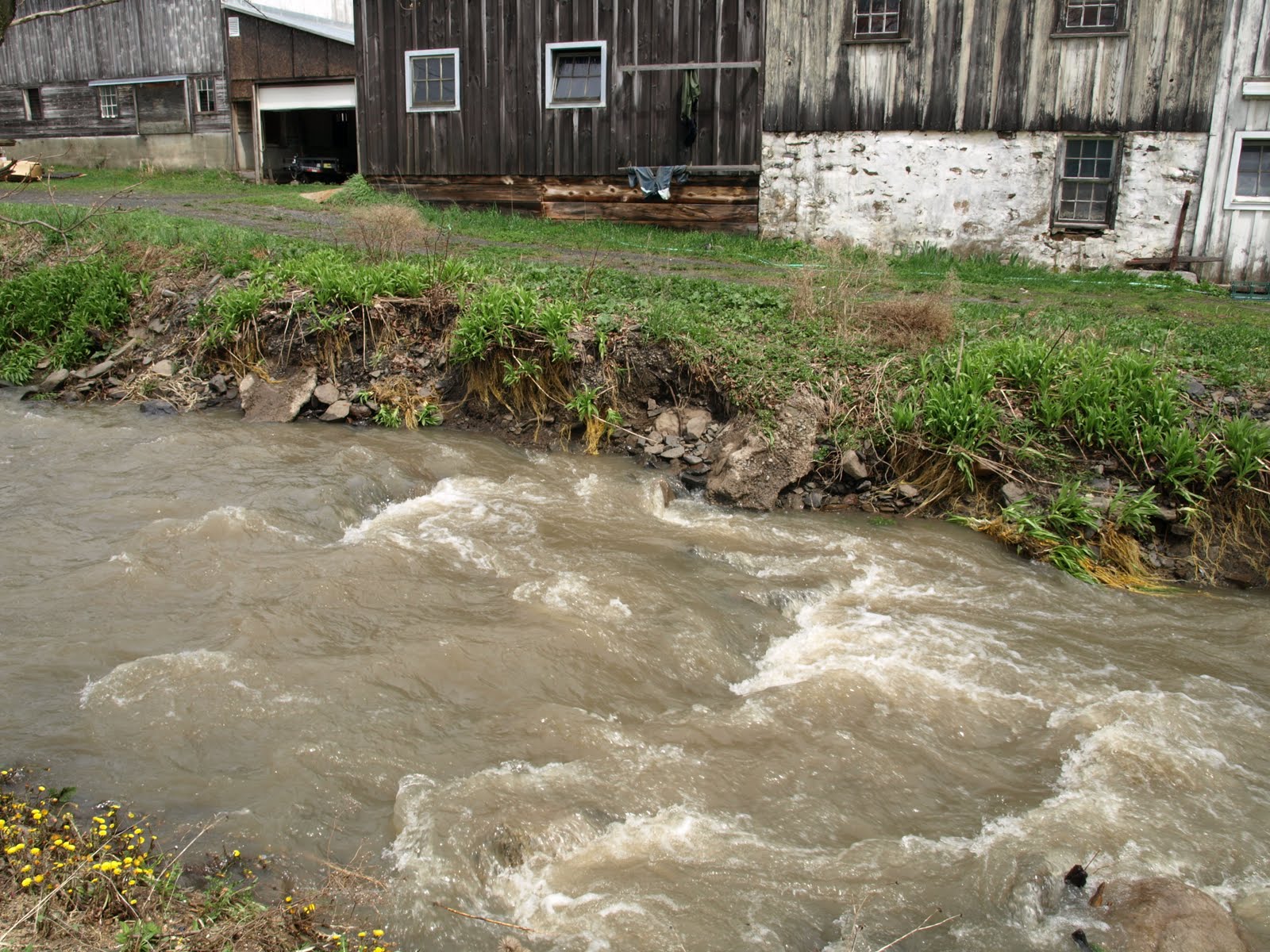
We've had a very wet spring so far this year. It has rained every day but one since April 17th, and the last few nights have been torrential in their output. The night before last night took the cake though. The legacy of flooding rain is writ large up and down our stream, from the falls all the way down to the big culvert just below our property line where Talbot creek crosses under Talbot road.


The farm was logged selectively in 2008 by men with big powerful machines who operated in a hurry without regard for the state of affairs when they left. In the gorge on the way back to the waterfall they dropped several large hemlock tops into the waterway. Last year our neighbor Don counseled me to go cut out the biggest and baddest of the lot in case of floods. He said he'd seen some doozies over the years - the Talbots once lost a combine to the creek sometime back in the 40's. His concern was about the little bridge that connects our farmyard (the house is on one side of the creek, the barns on the other). If a log jam tucked itself into our bridge we'd have big problems in a hurry. Thankfully the worst didn't happen. The logs and sticks that washed out of our woods cleared our bridge and lodged themselves downstream at the aforementioned (and shown) culvert.


The log in the middle of the frame has a large hewn notch in its side and came from our woods almost a mile upstream of this spot. One can just see the notch buried in small branches 6 or 8 feet back along the trunk. I know because I chopped that notch a few days ago when we cleared a trail through the logging slash to make the falls more accessible to small children or older folk who don't want to slog through mud. That notched log lay across the stream and I cut the notch to create a step. Now I know I should have saved myself the trouble.

More depressing, for it is irreplaceable, is the soil we lost in this event. Here you can see right outside our kitchen window the stream tore under day-lilies, exposing their roots.


Here we lost a swath of hayfield 4 or 5 feet wide the entire depth of the stream bed along a stretch 75 feet in length.


Those are two bad spots, but I've already noted a few others with missing/altered stream banks. So what is the cause? Clearly the rain in such sudden quantities can be implicated. The loggers who left trees in the stream contributed, since the wood jams scraping down the stream, catching and releasing, damages the banks as they flow. The previous generations of farmers who ran cows on the stream helped to channelize its course, making it flow faster. Unable to flood laterally, the only option left for the water is to accelerate, and the faster the flow the greater its erosive power. And stepping even farther back I suspect that the extirpation of the American Beaver from the woodlands of the east during the colonial and early American eras also played a role in carving the little gouge our stream now courses down. If you're curious about the incredible alteration in the hydrological cycle the North American/European fur trade caused, the book Water, by Alice Atwater, dwells on the topic for a few chapters. She opened my eyes to just how different our watersheds looked four or five hundred years ago when there were multiple small earthen dams on almost all small streams and most larger streams too.

This is just one small narrative thread that has come to my mind recently. I've been mentally stuck on the idea of causation and legacy for a few weeks now, perhaps because of all the baling twine, barbed wire, and partially rotten lumber I've been pulling out of compost piles, fields, pastures, and tree lines. I guess becoming a father recently has also put my mind to that particular track since I've found myself wanting to leave my child (children someday?) access to a world better than the one I now inhabit. I love it here, and I have a vision for the long term that is even brighter and more beautiful than the state of the farm right now. I don't think I'll live long enough to see everything I can dream up come to be, but it'll be a fun time heading that direction and with a little luck, a sense of humor, and some work I plan to leave future inhabitants of the farm a legacy to be thankful for, not one to be depressed or saddened by. Since I'm closing on a hopeful note I'll part with an image of a section of stream that proved itself resilient under the onslaught. Here there are willows rooted near the waterline low on the bank. Everywhere scrubby growth like this is established held together well during the flood and barely eroded. We now have plans to propagate willows like these up and down our stream.


-Edmund

Saturday, April 16, 2011

Hen Miscellany


I call him Buster. He is the sole remaining rooster for our flock, and I love his fluffy thighs. He has never threatened us with violence. We appreciate that and bless his life in return. He may also be the progenitor of birds unknown, but this is yet to be seen.

I heard from Edmund that if you want uniform fertilization for your eggs, you need to keep one rooster for every 10 hens. We have 22 hens right now, more than double what is advised. This would not be an issue if our hens were entirely disinterested in their own production.


But this is not the case. This hen went broody at the tail end of March. I went into the egg mobile one day and noticed that her head was unusually low, like you see it here. The Dark Cornish hens are very sleek when on their feet. Their feathers lie close to their bodies, making them look more like dinosaurs than the typical plump backyard hen. The day I noticed something was different, she had fluffed her plumage to fill the entire space of the nesting box.

A hen hatching out a bunch of adorable mutt-chicks sounds lovely to me (and sustainable, for that matter). But what doesn't sound as precious is the idea of her heating a bunch of unfertilized eggs for three weeks (or more) and then cleaning up a filthy mess while she, now disenfranchised, protests. There is just no way to know until one or the other happens. Oh well. We'll see.


So aside from going broody, the hens have taken to laying in unconventional places. Mostly they lay here in the hay.


While collecting these eggs, I heard a hen squawking from above the housing for the well in the red barn. I took out the ladder and found 9 eggs proceeding down the crevice by the wall.

I used them in a quiche with the only other thing we are producing on the farm right now - dandelion greens. It was wonderful. If you are reading this, and are in a climate similar to our own, now is the time! Bring in your dandelion greens before they become bitter!


So, beyond laying in unknown locations, or refusing me access, one hen surpassed the rest and forewent the shell entirely, laying an egg cloaked only in a membrane.


I didn't make anything with that. But I should have, because aside from being particularly naked, it looked perfectly good... when I got rid of it.

-Alanna