Friday, April 29, 2011

Legacy


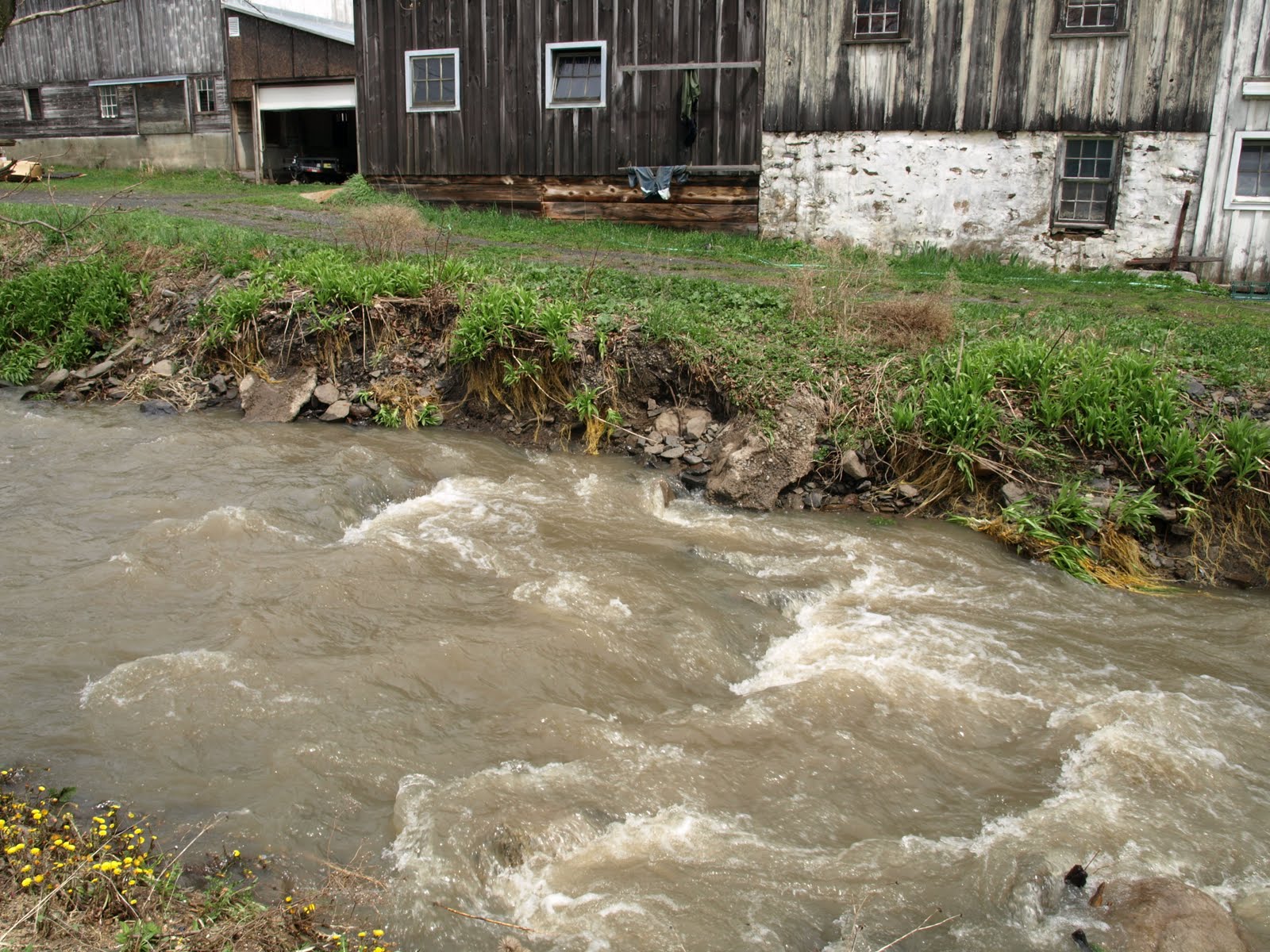
We've had a very wet spring so far this year. It has rained every day but one since April 17th, and the last few nights have been torrential in their output. The night before last night took the cake though. The legacy of flooding rain is writ large up and down our stream, from the falls all the way down to the big culvert just below our property line where Talbot creek crosses under Talbot road.


The farm was logged selectively in 2008 by men with big powerful machines who operated in a hurry without regard for the state of affairs when they left. In the gorge on the way back to the waterfall they dropped several large hemlock tops into the waterway. Last year our neighbor Don counseled me to go cut out the biggest and baddest of the lot in case of floods. He said he'd seen some doozies over the years - the Talbots once lost a combine to the creek sometime back in the 40's. His concern was about the little bridge that connects our farmyard (the house is on one side of the creek, the barns on the other). If a log jam tucked itself into our bridge we'd have big problems in a hurry. Thankfully the worst didn't happen. The logs and sticks that washed out of our woods cleared our bridge and lodged themselves downstream at the aforementioned (and shown) culvert.


The log in the middle of the frame has a large hewn notch in its side and came from our woods almost a mile upstream of this spot. One can just see the notch buried in small branches 6 or 8 feet back along the trunk. I know because I chopped that notch a few days ago when we cleared a trail through the logging slash to make the falls more accessible to small children or older folk who don't want to slog through mud. That notched log lay across the stream and I cut the notch to create a step. Now I know I should have saved myself the trouble.

More depressing, for it is irreplaceable, is the soil we lost in this event. Here you can see right outside our kitchen window the stream tore under day-lilies, exposing their roots.


Here we lost a swath of hayfield 4 or 5 feet wide the entire depth of the stream bed along a stretch 75 feet in length.


Those are two bad spots, but I've already noted a few others with missing/altered stream banks. So what is the cause? Clearly the rain in such sudden quantities can be implicated. The loggers who left trees in the stream contributed, since the wood jams scraping down the stream, catching and releasing, damages the banks as they flow. The previous generations of farmers who ran cows on the stream helped to channelize its course, making it flow faster. Unable to flood laterally, the only option left for the water is to accelerate, and the faster the flow the greater its erosive power. And stepping even farther back I suspect that the extirpation of the American Beaver from the woodlands of the east during the colonial and early American eras also played a role in carving the little gouge our stream now courses down. If you're curious about the incredible alteration in the hydrological cycle the North American/European fur trade caused, the book Water, by Alice Atwater, dwells on the topic for a few chapters. She opened my eyes to just how different our watersheds looked four or five hundred years ago when there were multiple small earthen dams on almost all small streams and most larger streams too.

This is just one small narrative thread that has come to my mind recently. I've been mentally stuck on the idea of causation and legacy for a few weeks now, perhaps because of all the baling twine, barbed wire, and partially rotten lumber I've been pulling out of compost piles, fields, pastures, and tree lines. I guess becoming a father recently has also put my mind to that particular track since I've found myself wanting to leave my child (children someday?) access to a world better than the one I now inhabit. I love it here, and I have a vision for the long term that is even brighter and more beautiful than the state of the farm right now. I don't think I'll live long enough to see everything I can dream up come to be, but it'll be a fun time heading that direction and with a little luck, a sense of humor, and some work I plan to leave future inhabitants of the farm a legacy to be thankful for, not one to be depressed or saddened by. Since I'm closing on a hopeful note I'll part with an image of a section of stream that proved itself resilient under the onslaught. Here there are willows rooted near the waterline low on the bank. Everywhere scrubby growth like this is established held together well during the flood and barely eroded. We now have plans to propagate willows like these up and down our stream.


-Edmund

Saturday, April 16, 2011

Hen Miscellany


I call him Buster. He is the sole remaining rooster for our flock, and I love his fluffy thighs. He has never threatened us with violence. We appreciate that and bless his life in return. He may also be the progenitor of birds unknown, but this is yet to be seen.

I heard from Edmund that if you want uniform fertilization for your eggs, you need to keep one rooster for every 10 hens. We have 22 hens right now, more than double what is advised. This would not be an issue if our hens were entirely disinterested in their own production.


But this is not the case. This hen went broody at the tail end of March. I went into the egg mobile one day and noticed that her head was unusually low, like you see it here. The Dark Cornish hens are very sleek when on their feet. Their feathers lie close to their bodies, making them look more like dinosaurs than the typical plump backyard hen. The day I noticed something was different, she had fluffed her plumage to fill the entire space of the nesting box.

A hen hatching out a bunch of adorable mutt-chicks sounds lovely to me (and sustainable, for that matter). But what doesn't sound as precious is the idea of her heating a bunch of unfertilized eggs for three weeks (or more) and then cleaning up a filthy mess while she, now disenfranchised, protests. There is just no way to know until one or the other happens. Oh well. We'll see.


So aside from going broody, the hens have taken to laying in unconventional places. Mostly they lay here in the hay.


While collecting these eggs, I heard a hen squawking from above the housing for the well in the red barn. I took out the ladder and found 9 eggs proceeding down the crevice by the wall.

I used them in a quiche with the only other thing we are producing on the farm right now - dandelion greens. It was wonderful. If you are reading this, and are in a climate similar to our own, now is the time! Bring in your dandelion greens before they become bitter!


So, beyond laying in unknown locations, or refusing me access, one hen surpassed the rest and forewent the shell entirely, laying an egg cloaked only in a membrane.


I didn't make anything with that. But I should have, because aside from being particularly naked, it looked perfectly good... when I got rid of it.

-Alanna

Sunday, April 10, 2011

It's Happening!


A few weeks ago Stephen Colbert had a series of shows where he spent time building up to the sale of his portrait. Each bit about the art auction included Colbert saying "it's happening!" in an enthusiastically earnest yet slightly self-mocking manner. During the episode of the auction he used the line several times, and we were greatly amused by it. In fact, I was amused enough to say it myself more than once about almost anything going on here at Cairncrest farm.

The current recipient of the "happening" phrase has been the garden. The garlic has emerged and I can see asparagus tips roughly flush with the soil surface. Normandy's brother Preston, Garth, and I spent hours in the garden the last two days plucking rocks and prepping beds for planting. Onions will be going in very soon, and depending on soil temperatures other crops will follow shortly.


There are many, many ways to layout a garden and grow vegetables. A little bit more detail about our gardening style may be of interest, so I'll try to summarize it as best I can. We dig 4x25 foot beds and then leave a 1 foot wide path before starting the next bed. This shape allows for easy harvesting of the whole grow area without having to step into the bed itself. The length makes for ready access to the middle of the beds without annoyingly long detours down, around, and back up the other side. We also left a few extra wide paths for cart, tractor, wheelbarrow, harvest, and tool staging. The wide paths are woodchipped for weed control. We tried chipping the narrow paths last year, but it was not ideal. Too many chips ended up in the beds and they made weeding the paths much more difficult since I weed them with a razor sharp grape hoe. The hoe hung up on the chips too much. Where I didn't get to spreading chips I found it much easier and faster to drag the tool. So this year I raked the chips back off the narrow paths.

I feel really lucky about the garden site we picked. We chose it out of location more than anything - it was a flatish area with slight southern exposure close to the buildings that receives full sun. It's on a small knoll so when we're working we have good visibility of approaching deliveries or the arrival of friends. The part I feel luckiest about is the soil. When we picked the site we knew the soil would have the final say as whether it would actually turn into a garden. Too much clay is quite a tough nut to crack in a vegetable garden but we don't have too much clay by any means. Testament to this fact is that we've already spent days in the garden digging while there are still patches of snow melting away around here. The ground is very wet, but the soil is still loose. When we had our soil tested this year the cation exchange capacity in the garden read 8.22 meq (this is quite low). Generally clay raises the exchange capacity, sand lowers it. With how low that number is we will most likely add clay over the years. Since it is a limited area I plan to go with the best - montmorillionite (bentonite). Exchange capacity can be thought of as a battery. The charges all need to be in balance to grow healthy plants. By increasing the exchange capacity one makes the battery itself bigger. But making that amendment is not urgent, much less imperative than fertilizer and compost. There's a lot more to tell, but it will have to wait. I'll end with a little plug -

Our gardening bible is Gardening When It Counts by Steve Solomon. He has formulas for COF (complete organic fertilizer), compost guidelines, and planting tips throughout. He gives advice for fertilizing and plant spacing dependent on budget and material availability. In his writing he comes across as a curmudgeonly grandad who wants things done right, and who really wants to see his readers to succeed. We were extremely pleased with the fruit of our labors using his methods last year, and this year looks to be even better since we now have a jump on things as opposed to a bunch of sod. If you have any aspirations to grow some of your own food I cannot recommend a better book. For the energy constrained future barreling our way, this book is "happening".

-Edmund

Wednesday, March 30, 2011

Is it super nice?


It depends who you ask. A week and a half ago, when the snow looked like it was going to make a hasty retreat, I decided to photograph its progression. You can see that progress is sure, but it is awfully subtle.


3/19/11

3/20/11

3/30/11
While I am aware that our pastures could be much greener by now, our chickens waste no energy on ideas like these.

Here they are taking a communal dust bath in the newly exposed soil. They are already foraging for a lot of their food. I put grain in their trough every day, but they are less interested than they were a week ago, preferring to roam broadly and nibble away at whatever they find. The difference is obvious. The yolks of our eggs have already deepened in color. I had one yesterday that would have rivaled an egg from the heat of summer.


Despite the fact that Spring is slow coming, we have begun preparations for the garden. Garth compiled a chart of everything we want to grow and divided our garden log by week. Every week in April begins with the question, "Is it super nice? consider planting..." It is wonderful to have the timing sorted out already. He seeded these soil blocks on March 13th with plants that require more time than our season allows: celeriac, celery, leeks, and cherry tomatoes. Everything has germinated now. Below are the leeks, bringing their heads up and out from under the surface.


Our 'Sweet Meat' squash, just days after harvest in September.

Our 'sweet meat' squash today.

And last year's garden is still giving. Apart from a softening collection of potatoes in our basement, these three squash are what remain of our haul. Their skin and flesh have changed drastically over the course of the last 6 months, but on the whole, they are still kicking. About a month ago we noticed that one had started to rot. Luckily, the undesirable parts are cut out quite easily, while the rest of the squash remains delicious. Perhaps this year's labors will go even further. That would be super nice.

-Alanna

Monday, March 21, 2011

Mini Egg

Nature offers many variations upon its own themes. Of particular interest is always the mini version of whatever we are used to. Among the eggs Alanna collected yesterday was a very small egg, it's circumference about the size of a silver dollar. It met its end like most of our eggs do: poached, with a little salt and pepper.

-Normandy


Thursday, March 17, 2011

the greenhorns


Last night Garth and I went to a screening of the greenhorns. It is a documentary made over the last three years, directed by the farmer and activist Severine von Tscharner Fleming. She was there to discuss the film and take questions afterwards. There was a lot of information to take in, and I am apprehensive that I will misrepresent the details here, so I have linked to their site above and below.

Severine, disappointed by the fact that so many films about America's food are horrifying and depressing, set out to make a film that showcased young farmers across the country- hence the moniker greenhorns. It was so vivifying to see people succeeding in many roughly sustainable ways. The USDA stipulates that anyone who has been farming for 10 years or less be considered a beginning farmer. I would agree with that. The average age of the American farmer is now 57 and it is estimated that tens of millions of acres will change hands in this country within the next ten years. There are a lot of educated and motivated young people who would like to make a go of farming, but more often than not, these same people do not have the buying power needed to acquire land for themselves. The network Severine and her fellow farmers are creating (The National Young Farmers' Coalition) could assist tremendously in this transition. For instance, after the screening, three audience members came up to Severine to say that they owned land and that they wanted it farmed. She may very well know people who are looking for a favorable land lease agreement that would permit them to begin farming in earnest. There is so much potential here!

The film is just one arm of a larger movement aimed at supporting, educating and connecting young farmers to each other. They have an interactive map where you can place your farm and possibly find other new farmers near you. They participate in public events to show off sustainable ideas for farming and life. I heard they will be demonstrating a bicycle powered wool carder and a bicycle powered sewing machine at the New Museum in early May. They are working to level the agricultural playing field and advocating for a new farm bill. This is exciting stuff and it is so integral to a successful future in this country. I can't wait to get involved. Please support them (us)!

-Alanna

Thursday, March 3, 2011

The Bennett House

As a newcomer to both this area of the country and to farming, I have found it a particular pleasure to hear our elderly neighbors talk about their pasts. Having an intellectual understanding of the transition from a largely agrarian to an industrial to a post-industrial (whatever that means, exactly) society is one thing, but talking to a man who remembers the arrival of tractor powered agriculture is quite another. I find some of the information relevant to my ambitions going forward, as when learning about the measures taken in the past to put up food for the winter, while other stories, though less applicable, perfectly evoke a time in this specific place - childhood games of Cops and Robbers played on horseback around a waterfall, or driving deer the length of the valley the first day of hunting season. Throughout these stories names crop up, of wives, friends and acquaintances who have passed away, and I am struck by how ephemeral, incomplete, and easily lost this sort of modest history is.


To an extent the landscape mirrors this cultural legacy, tired barns with their sagging roofs and houses with walls made of peculiar round stones held together by thick bands of mortar, a building style I have not seen elsewhere. On our farm we have two old barns, the house we are living in and, until recently, another small house house. In considering the future of these buildings, it is difficult to know how to balance practicality against nostalgia, the anticipated needs of the future against these physical conduits to the past.

We know that the hops barn was used for drying hops back when Central New York was the main source for that crop in the country, and that it was later converted into a shop and storage space. The large barn - made of one very old section and one more recent - held a tie stall dairy with hay storage above. The house we are all living in has undergone endless modifications over the decades. The kitchen used to be the woodshed, and at one time there were two separate, unconnected second floors. These three buildings are in varying degrees of health, and in the future we will have to decide whether to attempt to repair them at a steep cost or tear them down.

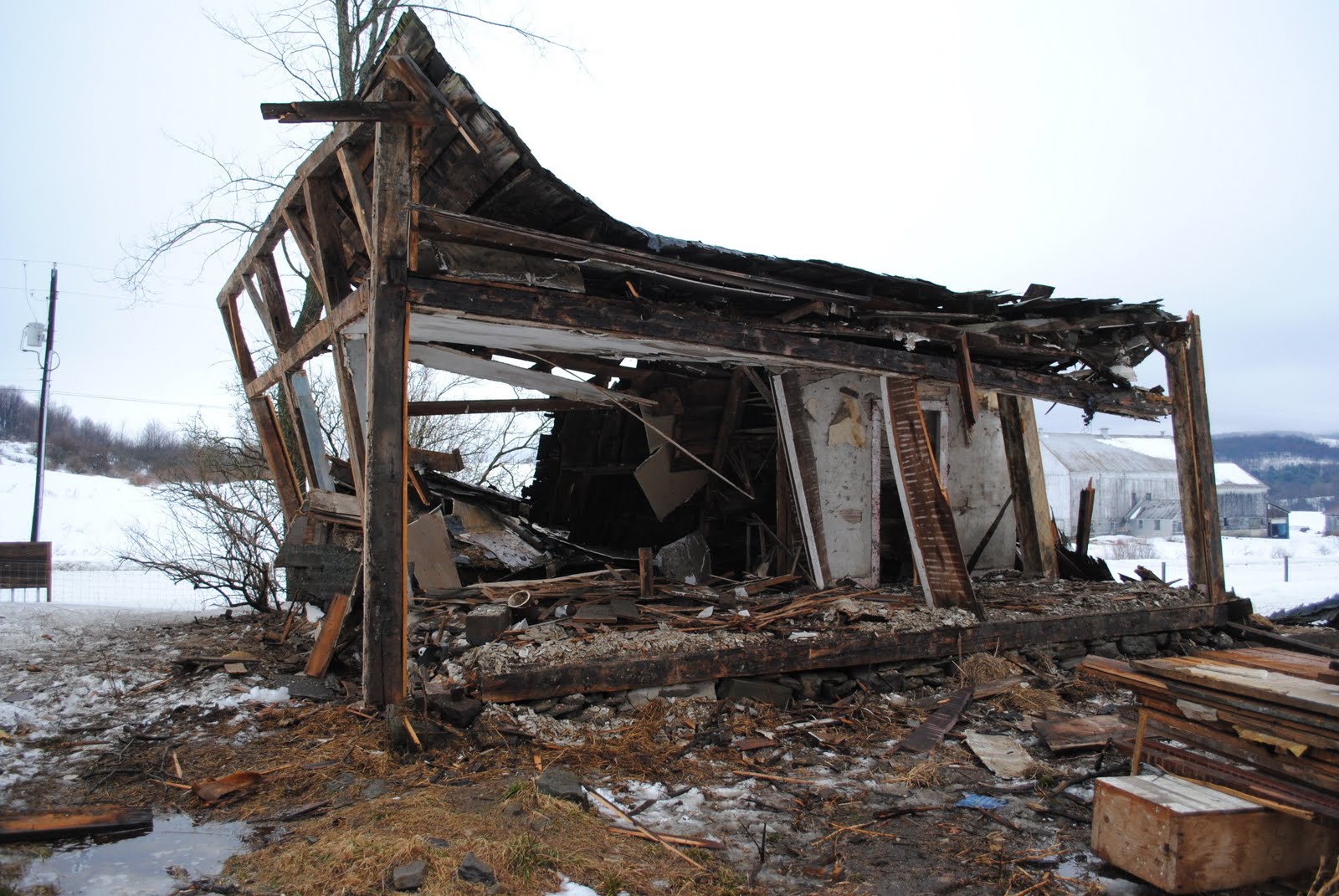
But the small house across the street, known as the Bennett house, presented no such difficult choice. Though the Realtor who sold us the farm claimed the prior owner had determined that the structure had "good bones," a conclusion he supposedly reached after climbing up to the second floor and jumping up and down, it was obvious to us from the hole in the roof and the extensive rot throughout that we would need to scrap it.


Last weekend my friend Ivan came up, intent on demolition. We started by throwing out the scraps of corrugated roofing, the remnants of an old vacuum line and the other bits of metal, as well as the sheets of plastic and other bulky trash that had accumulated over the years.


We next began tearing the splintered clapboard siding off, revealing the wide planks beneath.


Though hardly pristine, these boards were hefty enough to mill into quality lumber, so we set about removing and stacking them to the side.


Destroying the interior lathe and plaster wall was dusty, dirty work, but it was gratifying to scrape away this moldering skin to expose sound lumber beneath.


We removed more and more of the siding, revealing the frame. The timbers were hand-hewn, and the design was very simple. The rafters, with no ridge beam and no poles over the bents, would never be up to modern building codes, though that hadn't stopped the house from standing. Unfortunately, half of the frame was almost completely rotten. At one point the bones had certainly been good, but a decade or two of constant water damage had taken their toll.


Ivan left after two days, having helped remove all the exterior siding and a good bit of the interior lumber. On the third morning Edmund and I went to finish up, and he noticed that the frame had started to list on the rotten side - it appeared the thick siding boards had been playing a structural role. We debated whether or not to continue working on the first floor, and in the end we did, albeit only on the side where the supports were still sound. By lunch we had removed all we wanted, and a cold, driving rain had started to fall.

Inside, before we sat down to eat, Edmund said he did not expect the house to stand through the night. As he spoke he looked out the window and saw that it had in fact already collapsed. None of us saw it fall, so we do not know whether we would have had time to get out. Regardless we felt lucky that our nascent farming careers were not squashed.


From this wreckage we tore out a good stack of rafters and floor joists, as well as the last bits of interior wall. All that remains now is a whole lot of cleaning up.


Hidden beneath a section of plaster on the second floor Ivan and I found some flaking bits of newspaper pasted to the boards. They were too torn up to read the columns, but the date, 1859, was legible. While taking down the building was the only thing to do, and while I do not feel sad about it, I nevertheless have a sense of awe at putting an end to a structure that stood at the start of the Civil War and kept standing quietly at the bottom of a hillside pasture ever since.
We know a little about it. At one point the house, along with 27 acres, was its own farm, and more recently it served as housing for hired hands and their families. Though it had running water and electricity, it never had a bathroom. The windows were single pane, and the walls had no insulation at all. I wonder if its owners and occupants were content, and I wonder if I would be in such modest circumstances.

I try my very best to do away with any illusions that the past was in any way perfect, but I also do not hold to the idea that all or even the majority of changes have been for the better. For several years, but particularly since moving to the farm, I have been interested in the question of how to properly live in a place. Much of this involves looking forward and planning, as we decide what animals to get and how to manage them, what infrastructure to focus on and where to put it. But I hope to be aware of what has come before, and to give the past particular to here the consideration it deserves.


-Garth