Monday, January 23, 2012

Garden in Mind


It's winter. At least it seems that way sometimes. Today it's nearing 42 F. and drizzling, with strong gusts from the South. Yesterday I stood near the egg mobile in a raking light that revealed the whims of our flock. They were scripted in lines across the snow, a visual record of their humble habits - a quick jaunt to a mound of high grass, a pause to peck at the impression left by a footstep, a new path home to the feeder.

This same light gave evidence of others' whereabouts. Of course we are cognizant of the mice in our house. How could we not be? They are louder than we are most days. 'Vermin Supreme' is what we've taken to calling the cadre upstairs. Apparently they approach our door in nearly the same way we do.


While the mice ferret away in our walls, and the chickens find satisfaction around life's edges, thoughts of our garden take up firm residence in my mind. This is where I last saw it.

(This photo is no small testament to the biodegradability of pants, by the way. I pulled this skeleton from the goat manure compost that came with the farm. David, who was diligently laboring away with us in the Fall, held them up for the photo once they'd been unearthed. Incredible. My fears of everlasting cast-offs are crumbling.)

SEEDS! Garth and I spent hours with a few catalogues this week and the lists we compiled from our last growing season. What did well? What did poorly? What did we want more of? Less? What's new? I have to give an enthusiastic round of applause to FEDCO-SEEDS. We have ordered our seeds primarily from Johnny's in the past. Don't get me wrong. They are great - proven seeds with fantastic turn around and customer service. We even ordered a number of things from them this year, but they don't encourage the whimsy gardener with their expensive small packets. Their seeds become very competitively priced once you buy 5000 or more of them, but we want to experiment in our garden. We have no idea how a new vegetable will turn out, or if we'll like them once they do, and paying a lot for a small number of seeds is not super fun. FedCo, by comparison, was perfect for us. They offer a number of open-pollinated seeds and they sell their packets cheaply. They write very informative reviews for each variety they offer (my best impersonation of their style - 'This heirloom beet was first made public by Jim Carnville (made up name) of Iowa in 1824. It outperformed Detroit Dark Red in last years growing trial, bulking up quickly, and and the taste, though milder than Bull's Blood, was the favorite in the 2011 Taste the Harvest competition in Maine. It stores well and doesn't get tough if you let it mature late into the season...' you get the gist). They offer FREE SHIPPING (shipping is often a large proportion of the cost of ordering seeds), and they give 10% off orders greater than $100. Man are they good! That said, we haven't seen how their seeds grow yet, but we'll keep you posted.

Lastly, I want to add a special thank you to Jane Ireland. She lives nearby and called me up after reading through the entirety of our blog. After consulting with her sister, who is also an avid gardener, she recommended we grow a strong smelling heirloom marigold. She told me that flea beetles (the bane of this gardener in Spring) follow their noses to our plants. Planting marigolds around the garden and amid the beds will disrupt them enough to give our plants a leg up in the world. We ordered two kinds, and I am thrilled to have the advice of someone whose fought similar battles organically in this area. Thanks Jane!

-Alanna

Monday, January 16, 2012

The Fat of the Land


As a food producer, one of my interests is the relationship between diet and health. In part, this is because I think much of the conventional wisdom concerning the healthiest way to eat is flawed, and iconoclastic positions are exciting things to hold. (Which, in my opinion, can be one of the risks of holding them.) But what I find most fascinating about human diet is the way it highlights the limits of science.

Any dietary change that can improve health outcomes, even slightly, can have a significant positive impact when practiced by a large population. The incentive for organizations, public and private, to promote healthy eating habits is understandable, and the impulse to do so based on incomplete or ambiguous evidence is also understandable, because virtually all evidence in this particular area is incomplete, ambiguous, or both.

A few examples:
1.) Many studies, even the ones that make headlines in the NYT science section, are performed on mice or rats. Often, these mice or rats have been selectively bred for a particular trait, such as a predisposition to weight gain or diabetes. Human metabolism may not be identical to mouse metabolism, particularly selectively bred mouse metabolism.
2.) It is very difficult to establish a good control, particularly with macro-nutrients. For example, in an effort to study diets with a varying amount of protein, scientists might limit total calories to 1600. One group would get 40% of calories from protein, 30% each from fat and carbohydrates. The second "control" group might get 20% from protein, and 40% each from fat and carbohydrates. This would be a particularly poorly designed study, in that all three macro nutrient ratios are different. But even if carbohydrates or fat was kept constant, the other would still have to change to keep the caloric total identical. In other words, there is no way to have a single variable.
3.) Epidemiological studies are always problematic in that the most they can establish is correlation, but with something as complicated as diet, particularly when the studies are based on recalled food intake, they approach meaninglessness.
4.) All humans, so far as I know, suffer to a greater or lesser extent from confirmation bias. Researchers and institutions that have been offering strongly held opinions are likely to discover information that supports these opinions. I certainly view all dietary writing and studies through my particular prism, try as I do to judge them based on their objective merits.

If you're like me, this is about the point in an article when you start wondering what it has to do with gardening.

As previously mentioned on this blog, we have been making an effort to amend the soil of our garden to more ideal ratios, and we would eventually like to remineralize our entire farm. In part, this is justifiable in terms of simple economics - there comes a point at which a lack of calcium will seriously inhibit the growth of a crop or pasture. Yet I still believe it is worth the time to go beyond assuring that the soil has no gross deficiencies, and to make it have as close to perfect as possible a balance of minerals.


There are numerous difficulties.

A few examples:
1.) Soil tests are notoriously variable, based not only on the lab conducting the test, but even due to changing soil characteristics from one month to the next.
2.) There is no universally agreed upon ideal soil profile.
3.) Different amendments, even when providing the same quantity of a mineral by weight, behave quite differently.
4.) Soil is constantly changing - microbiological activity binds up certain nutrients while making others available, roots tap deep mineral sources and draw them to the surface, precipitation leaches each mineral at a different rate, organic matter and mycorrhizal activity in part regulate which of the nutrients in the soil are actually accessible to the the crop or forage.
5.) In trying to translate soil amendment to health, a long, flimsy chain is forged - amend soil (was it properly amended? are the minerals truly available for plant uptake?), grow a crop or forage (what variety? how did the weather conditions alter the quality of the crop?), feed this to a human or animal (all of the issues touched on in the discussion above), and then try to extract some substantial information from the results. William Albrecht's work is the most compelling I've read, but any attempt to deal with issues of this complexity will never be as certain as the link between vitamin C deficiency and scurvy. (And even this clear-cut deficiency disease is significantly more complicated than losing your teeth if you don't eat citrus.)

To me, this is a wonderful state of affairs. Depending on your viewpoint, the world either is or is not completely mechanistic. We have certainly organized large sections of our society around the portions of the world that can easily be mechanized for the sake of huge improvements in efficiency this allows. But what I'm describing, though proposed mechanisms and causal relationships can be speculated upon and doubtless do exist for even so complex a subject as the soil/health relationship, for human purposes, is not mechanistic.

We can take our farm and try one protocol for grazing or soil amending and get great results. But there are so many variables - hundreds beyond those few I've touched on - that it is impossible to foster a delusion that we actually know in the rigorous sense of the term what is going on, to what, if any, extent our actions had a positive result, let alone whether they would have a positive result somewhere else. Certainly, scrutiny and measurement are critical to assessing the impact of an action. But so are intuition, guesswork, gut feeling - all those horribly inaccurate, quite rightly unscientific human traits - and this is immensely enjoyable. There are few areas, let alone critically important areas such as food production, in which specific, unique decision making is practiced so regularly.


I enjoy science a great deal, and I think it is singularly capable of illuminating aspects of how the world works. Even in areas as fraught as diet and soil health, the amount of useful information available is staggering, and I'm grateful to have it. But faith in science is so ingrained that it can easily lead to the assumption that answers exist when they don't. So I will keep testing the soil and amending it in ways that I believe will improve its characteristics, because I believe this will ultimately lead to healthier land, healthier plants, healthier animals, healthier, happier people. Just don't ask me to prove it.

-Garth

Sunday, January 8, 2012

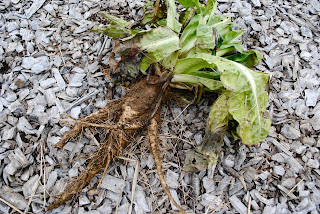
Endive - Winter's First Fruit


It's striking that the first emanation of new life here on the farm, in this new year, is the energy of this root. Endive is a curious vegetable.

We planted the better part of one whole bed in our garden to endive seed in the early Spring. They sprouted uniformly and grew with vigor. In the row they looked like gigantic dandelions, albeit lacking the dandelion's other defining features - the glorious yellow flower forming those weightless, reproductive orbs. Summer turned over into Fall, and they remained in place. We let them weather a few hard frosts before harvesting the roots. This encourages them to sprout readily when the time is right.


The Bubels, in their book Root Cellaring, suggest that any root larger than 1" in diameter will yield a tender top when forced . We found our roots had outdone themselves - many of them measuring 2.5 -3" at the head.
Garth dug each plant, removed the withering foliage, and packed the roots into used feed bags with some moist sand. The stuffed bags were placed next to our cage of root vegetables on the dirt floor of our basement. No, the root cellar didn't make the cut last year, so our winter storage is fumbling along below us (it's a little too warm and bright down there to be ideal).


About six weeks before we anticipated wanting fresh greens in winter, we began forcing them. Oh the relentless calender! Garth brought down his five gallon beer brewing bucket from the top of the hops barn. It has holes all through the bottom - adequate drainage. I packed 10 roots in together, cheek by jowl, and filled in the remaining spaces with sand. All the necessary energy is right there in the root, so the medium it's forced in doesn't matter at all. Thankfully Garth had just swept up a summer's worth of activity in the wood shop, just as I was looking for saw dust (from not pressure treated lumber). I moistened the wood shavings and filled the bucket to the brim. In the presence of light, endive will become excessively bitter. I put some wet newspaper over the top and stuck this whole contraption under the desk in the living room. A steady temperature of 50-60 degrees F is ideal for forcing endive.


We kept an eye on them, moistening the wood shavings every week or so, until a pale leaf appeared at the surface. It was kind of a touchy job - heaving handful after handful of musty saw dust into a second bucket, searching for the base of the plant with a knife, all the while trying not to harm its tender shoot. They emerged measuring between 4 and 6 inches. The saw dust came off quite easily under the faucet. I cut a piece of irish bacon into small cubes and browned it with a bay leaf. I then removed the pork and sauteed the chopped endive in the warm pan, adding the bacon pieces back into the mix when the leaves had just softened. We enjoyed this in the company of two other farmers who had stopped in for a night and morning. Staring out the window at the blowing snow -it was a wonderful way to appreciate a winter.

- Alanna

Tuesday, November 29, 2011

Mixed Bag


Life is a mixed bag.

Some of you may remember all the rain at the end of August and how hurricane Irene really walloped our egg mobile -hens adrift - poultry stress - egg laying cuts - hello, molt! - egg laying ceased.


I put a photo of this hen up last week to introduce our gratitude series and to draw a comparison between our infrequent posts and her infrequent feathers. She caught my eye because she looked so remarkably disheveled. She was one of the last to molt and seemed to have a rougher go of it than the others. Even though it has been a very mild November, it is colder at night now than it was in September.

Our flock has been turning in to roost in the early afternoon before the sun is even down. Once last week I had come in (to the egg mobile) around 3:30pm to check their feed and found them already in quiet repose, lined up along their horizontal perches with thin veils drawn over their eyeballs. This hen was the exception. She was trying to keep herself warm in the splattering of straw that lined her nesting box, looking alert and anxiously curious.

I found her dead beneath the egg mobile on Thanksgiving. I was pushing spent feed over the edge of the trough feeder and noticed a little mess of feathers through the hog fencing beneath my feet. I was worried that she had been cannibalized by the others, or mauled by some ferrel predator, but when I pulled her out it was clear that she had just died silently, ignored by her companions. Chickens are funny that way. One of them was pecking food from around her corpse. Another was enjoying a dust bath by her side. Whatever. Life was too cold for her. She didn't have her feathers. We'll just carry on. I imagine that is what the flock must have been thinking, but I realize that's just what I've been thinking.

The upshot is that after a little less than three weeks with a light bulb on a timer in the hen house (and I thought I got up early), we have our first white egg today. We haven't seen one in months. On the whole, the group has gone from looking dusty and dull to being full of vibrant life and color. Their breasts are a rich orange and gold ochre. Their forms look robust once again. A second laying season commences; life churns onward.


- Alanna

Thursday, November 24, 2011

Thank You


Today I am grateful that the farm exists in my life, and that we get to share it with all of you. I feel so blessed to be working collectively on something that requires so much of us and rewards us so readily. I couldn't have imagined the stream of people who've told me how happy they feel when reading the occasional blog post from us. Some of these people have felt motivated enough to visit us here, and many of them are coming from far away. As individuals we are connected to a diverse group of people. Some who were perfect strangers to me have come here because they loved one of us well. I've gotten to eat with them, work with them, exchange ideas and get a feel for each person's unique quality. I just didn't picture this when we bought the farm. I hoped we'd see people, but I just didn't know. It's like hoping for light, and getting a rainbow. Thank you.


This is Kristina, cleaning bits of venison off of a butcher's saw we inherited when we bought the farm. Thanksgiving overlapped with the cutting and wrapping of Ed's second deer. Kristina just sailed along with us. What a hand!

- Alanna

Wednesday, November 23, 2011

Radiant Heat


This series of gratitude posts we have been writing this week leading up to Thanksgiving has given me the lens with which to see my humble life for the rich and rewarding venture that it is. I suppose it is the nature of gratitude, to bleed into every cranny to reveal things small and large as comfort and grace.
This old farmhouse we live in has an oil furnace, though the neighbors who drive by can tell that we heat mostly with wood because we have stacks and stacks of logs on our front porch. Those of you who heat with wood know the joys and grievances of such a method: the radiant nature of the heat, and the inevitable cold rooms, the splitting, stacking, soot and smoke. Yet, I suppose I want to express my gratitude of our stove, for it is a podding, reliable workhorse. Most mornings I am not the first to arise, and I often walk into the kitchen to find a fire already crackling away. Some days, like today, there was coffee made, and it is for these small kindnesses we do for each other that I am grateful as well.
This year more than most I have been on the receiving end of such kindness, as I have become a mother this year. I suppose I have done my fair share of giving as well (the wakeful nights, the diapers, and countless back-pats and kisses). The limitations of my time and energy have also been a lens through which I can appreciate anew the pleasure of a warm fire, friendships and a few hours of sleep!


-Normandy

Tuesday, November 22, 2011

Garden Bonanza

Raspberries
blackberries
elderberries
blueberries
rhubarb
summer squash
sweet meat squash
onions (3 kinds)
garlic (3 kinds)
turnips
kohlrabi
parsnips
chard
lettuce (2 kinds)
cabbage
Asian cabbage
broccoli
brussel sprouts
golden tomatoes
asparagus
string beans
pole beans
Jacob's Cattle beans
Ken's beans
sugar snap peas
sweet potatoes
white potatoes
mustard greens
fennel
leeks
celery
celery root
beets
carrots
corn
kale
not to mention the blackberries, raspberries, ramps and apples growing wild on our property.

Our garden this year was ambitious and splendid. I am grateful to benefit from our collective goals for growing much of our own food. The accomplishments we have can be grander, broader and deeper than any of us would be able to do on our own. Those readers who grow vegetables themselves know the sweetness with which one's own food is eaten. What joy!
Tonight the four of us are going to sit down and do some planning for the coming year. It feels great to be a part of a team and watch our vision evolve and unfold.

-Normandy