-Alanna
Tuesday, September 21, 2010
Sunday, September 19, 2010
Mead - or is it Melomel?
Readers of this blog will remember the post in which our harvest of elderberries was detailed. There were three such trips, yielding a total of roughly eight pounds.
But the truth about elderberries is that they taste a bit funny. They are quite tart, with noticeable tannins, and even a little bitterness. Their flavor is so distinct that I cannot think of anything similar enough to mention. I mean, I could say they taste like black cherry, or like melon, or I could get crazy and claim to detect notes of leather or tobacco, but I would just be making things up, and I only do that when I'm tasting wine.
It had been my plan from early on in the harvest to make the elderberries into a mead. Weeks ago Alanna bought twelve pounds of honey and a pack of wine yeast for me at the Little Falls co-op, and I already had the carboys and funnels and airlocks necessary for home fermentation.
I started out attempting to keep everything as sterile as I would for brewing beer. But about half an hour into my preparations I realized that I was going to be dumping a ton of uncooked fruit and honey into the mix, and I stopped worrying about airborne particulates and other such ephemera.
Wine is fermented grape juice, beer is fermented barley sugars, cider is fermented apple juice, and mead is fermented honey. So it makes sense that the quality of the honey in large part determines the quality of the mead. The stuff I used came from a local place, and Alanna, who is much more expert at judging honey quality than I, thought it looked and smelled good.
After mixing it in with about four and a half gallons of water, I pitched the yeast to it and put it into the carboy. Then I set about sludging all the thawed out berries in. They turned the whole thing a ridiculous purple color.
I put on an airlock, and the next morning I was rewarded with a vigorous fermentation.
This is my first attempt at making mead, (or melomel, since it has fruit in it,) and I don't know what to expect. Was not pasteurizing a mistake? Will the elderberries taste crazy? Will the fermentation stick? Is 60 a good fermentation temperature? Will it really need to age a year after primary fermentation if I want it to taste decent? Only time will tell.
-Garth
Thursday, September 16, 2010
Onions
I have it in my mind that a great cook once claimed that "all great recipes start with chopping onions," but a solid fifteen seconds of googling yielded no results, so maybe I imagined it. At any rate, almost all great recipes in the Alden-Brown-Rose household begin this way, and since onions theoretically keep very well, we grew a whole bunch this year. We planted about 1200, and I'm guessing that between germination failures and poor development, we harvested roughly 2/3 that number. Here they are lying on our wood pile.
In this picture the tops are still on, but I have since chopped them off. Most of them had wilted, though a number had not. I will be curious to see if this affects their keeping potential. After they have cured a bit more it will be time to put them into storage. Onions prefer cool temperatures, but they require considerably lower humidity than potatoes, cabbages, and other long-storing vegetables. So perhaps we will put them upstairs, where it is quite cool and not so damp as the basement. The winter squash, if they manage to ripen, will need lower humidity and a more moderate temperature, so perhaps they will get to stay in the living room.
This is a picture of my lovely wife holding a bouquet of onions that weren't quite big enough to cure.
-Garth
Friday, September 3, 2010
Oil: the coming end of an era
"Oh my gosh. Do you know what you're wearing? Did you do that on purpose?"
These were statements made by me at lunch a day ago when I looked across the table at Edmund and saw the image on his faded t-shirt. At first Edmund smiled and denied having chosen that particularly bad looking t-shirt for any reason, but he acknowledged the obvious metaphor.
It was in effect a conceptual art or performance piece, because just seeing it across the table broke a window through my consciousness. There we were eating lunch. We were eating at a time when many other people up the Eastern seaboard were also eating. The proud tractor on Ed's shirt had shrunk in the sun. The little plasticky puzzle pieces were contracting onto themselves, tearing away from the cotton and falling off. The mammoth machine at the forefront of this model farm is fading into obsolescence as oil becomes harder to extract and less available (tractors may be the last mouths we feed, but the point remains the same- oil is not forever). But hardly anyone is talking about it. The only reason we were all eating at that moment was our indebtedness to fossil fuels. Seriously. They are the founders of the feast. We grew a good portion of what we were eating that day ourselves, but even so, the garden was plowed with a diesel powered tractor and the seeds we planted were shipped to us. It is endemic. There is hardly anything I can think of that does not arguably rely on it in some way. Fossil fuels are dense with energy and have been the arbiter of this marvelous global interconnectedness we rely on. But why are we counting on a continued stream of energy like that when it is becoming increasingly apparent that it is not reliable? A report compiled by the German military reviewing the risks inherent in the face of peak oil was just leaked and posted at The Oil Drum. I am comforted that people are taking the severity of the situation to heart and preparing for that day now, but mostly I am at a loss about what I can do. I don't know a different way yet. I don't know many people who can remember one. The last century has made us helpless in a way, but it also brought us a vast amount of knowledge that will inform our decisions in the coming challenges. We'll need the help.
-Alanna
Sunday, August 29, 2010
Get it while the getting's good
The light is quickly fading, rushing to a place beyond where I can see, feigning shy and tired. We are scrambling to bring in what we can while we can, kicking around in the abundance of all the light and water that has passed through and over our land this summer. The wild animals here are no exception. They feel the present urgency as well as we do. Which is why they are bringing in their harvest too.
We dug the remaining beds of waxy red potatoes yesterday. We brought in quite a haul.
You can leave them in the soil and store them there until you are ready to eat them, but the soil here is very moist right now. Their tops have been withered for about three weeks. With the scab worsening and competition from other hungry mouths below the surface, it seemed imperative to gather them from the ground now. We are taking the advise of a book on root cellaring and curing them for two weeks before storing them. They are laid out on shelves of an unused book case upstairs. They are meant to sit like this at a temperature between 60 and 75 degrees without exposure to wind, sun, or moisture. I covered the front of the shelf with a large moving blanket. During this time they will repair any damage to their skins and harden off, making them more rot resistant than they would be otherwise. I've never done this before. It is amazing that a potato will heal itself prior to storage if given the right conditions.
And even though we are preoccupied with gathering and storing we are also planting things out. Edmund and I planted 53 small hazelnut trees on Friday. We planted most of them along the western side of our garden on about 4 foot centers. They will grow like shrubs and provide a windbreak for the garden. We planted the remainder along the North side at a greater distance from one another to maximize their fruit yield. If we keep the weeds down around them and fertilize them heavily next year, we may get a hazelnut crop in three years. This is all part of our plan to have living fences that will act both as boundary and as sanctuary, drawing birds and insects far and wide.
Today I plan to plant a cover crop over the beds we've harvested thus far. Either field peas or rye grass, depending on how I feel. These green manures will capitalize on what little light we have left.
-Alanna
Monday, August 23, 2010
Egg Mobile
At the end of May, Garth was the lucky guy at a poorly attended equipment auction who got a fine deal on two sets of running gear. If you are at all like me, you don't know what running gear means. It is basically a metal frame with four wheels and a tongue at the front where a tractor can attach to it. The pair he bought were not fancy, but they were in useable condition. One of them has become the designated wagon for hauling things on the farm and the other is now the 'egg mobile'.
There have been times when the piles of scrap metal around have felt like an ugly burden, but this was not one of them. When the project was complete Garth was happy to report that the only brand new materials he used were the hook and eye pieces that latch the doors closed. It brings a bit of vaudeville charm that wouldn't otherwise be gracing our pastures.


The chickens have been enjoying the freedom within their routine. Someone props open the door to their place in the morning after the cow chores and they are left alone until sundown when they are closed in for the night. I went to bring them some compost today and found 1/2 of the flock had joined the cows while the other half was pecking around in tall grass near the wagon.
The chicken with its leg lifted is the finest example of the Silver Penciled Plymouth Rock breed that we have. The black and white one in front was supposed to look like that, but is not true to type. The zebra striped one on the right is an extra that the hatchery threw in, most likely a Barred Rock. The two in the rear are Rose Comb Brown Leghorns.
So we have been calling it the egg mobile since its inception in anticipation of brighter days to come when the birds are actually mature enough to lay. We had not filled their nesting boxes with saw dust because we just did not think they were big enough yet. Then one day, about two weeks ago, before readying the barn for Ebon to arrive, I walked past this overturned water tank and noticed... our first egg! We filled their nesting boxes with saw dust in a hurry after that and have been collecting between 2 and 5 eggs a day ever since.
Like the eggs of most young hens, they are small, but they will get bigger as the birds mature. The deep color of their yolks reveal the vitamin rich forage in their diet. Chickens fix beta-carotene in both their yolks and their whites. We cracked 6 of our eggs and two from a dozen that I had bought at a farmers' market for comparison (they are the two with larger yolks). For the record, I have bought many eggs from local farmers that look a lot better than that pale one and we obviously did not know how pallid it was until we had cracked it. The other large one looks better, good even, but in any light, our eggs stand out.
It is very troubling to think of the millions of eggs being recalled at the moment due to salmonella contamination and the scores of sickened people. A revolting inversion of 'farming', concealed at most times, is again revealing its true form on a grand stage. I am sorry to be one of the few Americans thrilled by the prospect of eating eggs right now, but these eggs deserve to be celebrated. Chickens, carry on!
-Alanna
Monday, August 16, 2010
The forest bears fruit
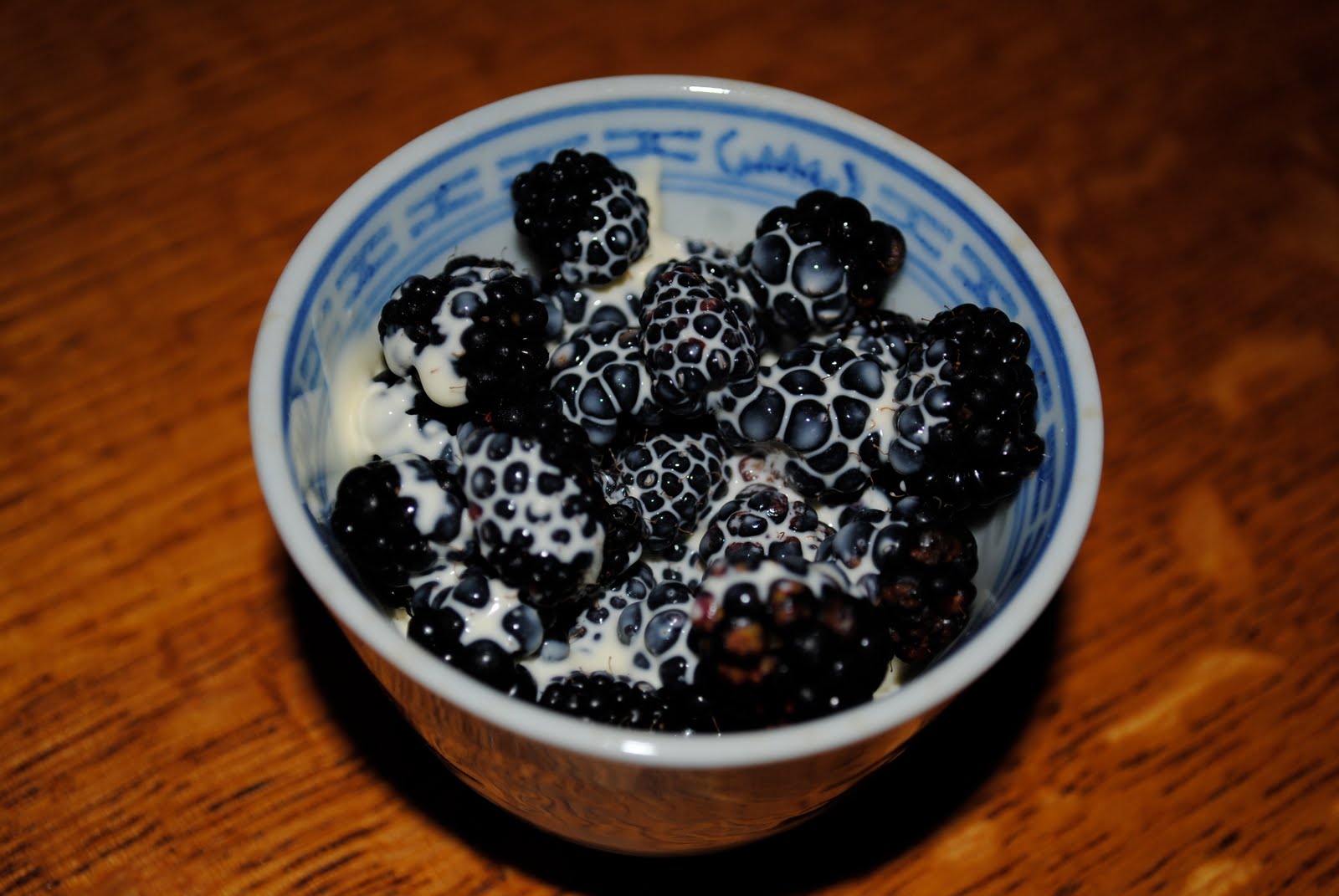
I have been calling them blackberries, but they are not like other blackberries I have had. They are wild. They offer a fleeting sweet burst followed by a lingering bitterness reminiscent of grapefruit.
-Alanna
Subscribe to:
Posts (Atom)