Friday, October 19, 2012

My Brother the Goose Whisperer

While the competing views of nature as either bleak waste, red in tooth and claw, or a Disneyland inhabited by anthropomorphic herbivores still shape many discussions of the place of humans in the world, the practical reality is not so simple, as I'm sure you, dear reader, know well. There's lots to say and lots that's been said about the predator/prey relationship, and the strange subversion of this relationship that is animal husbandry. But this is not my interest today. Today I want to write about the unexpected, the beauty and the wonder that abound.

We are well into fall, and most of the trees on the farm have disrobed, leaving their hardened skeletons to chatter at one another through another blustery winter. On several long drives over the past weeks I've been struck by the subtle shifts in foliage that accompany descent and ascent, the confluence of temperature and time that shape the colors of autumn - drop into the Hudson valley, and the trees are two weeks behind, still merry in their reds and aflame in their oranges.

Last spring, out hunting turkey, a bobcat padded through the morning woods, twenty feet from where my brother and I sat. Its gray ears twitched at my brother's whisper, and it turned and vanished silently back into the trees.

I heard little from the coyotes last year, but of late their eerie yips and howls have filled the night, exciting a frenzy in the village dogs and keeping me from sleep with thoughts of our calves. Last week I saw one at midday work slowly through my neighbor's pasture, stalking and pouncing after mice.

But there is something on our farm beside which these encounters and observations pale. It hinges on a relationship between human and animal more profound than that of a skilled rider and his mount. The songs of humpback whales are justifiably celebrated, but here we have a music far more haunting, a music which rings out through the valley, more beautiful than the peels of the Maria Glorioso or a Bach partita, more moving than any aria, a harmony which can only be termed sublime.


-Garth

Sunday, October 7, 2012

Squash Harvest

Where do we store 955 pounds of squash?


Almost anywhere. 

- Alanna

Friday, September 7, 2012

Lacto-fermented Sauerkraut Redux

Garth and I gave and received utilitarian gifts this year. I was fueled by the irritation of using things not suited to the purpose, and I can't speak to Garth's motivation. So, although we're repeating the same tasks we took up last year, we have gained something from our trials and acquired better tools, which have refined the process immensely. The small things add up. Let me get into specifics.


It is kraut time. Last year the cabbages we sowed directly were destroyed by slugs, and we had to purchase starts at a nearby greenhouse (thank you Sirkos!). Unfortunately, the starts we did buy were begun earlier than we would have wanted. This meant that last year our cabbage crop was splitting open and beginning to rot before we, or the season, were ready. But this year, with the hoop house Garth built, we were able to start them later in soil blocks and grow them larger before planting them out. It has been very successful. Look at how tight these heads are! The variety is 'Storage No. 4', which we chose because it was developed in Cortland, NY.


Last year, we tried using a sealable five gallon bucket to lacto-ferment the cabbage in. We filled a plastic bag with salt water to weight the cabbage down with. The results were tasty, but the process was touchy, and the container was never the same. I cleaned it twice and dried it in the sun before storing anything else in it, but that just wasn't enough. We had a bag of macadamia nuts - double bagged actually, if memory serves - that took on that distinct cabbagey flavor. I sacrificed the bucket to construction purposes. 

For Garth's birthday we bought these polish fermenting crocks. The design is really sophisticated. Leave a comment if you want me to go into it, but the short story is that they are ceramic, non-porous and highly suited to the task (and significantly cheaper than their German counterparts).


And Garth gave me this huge stock pot for Christmas. Although it is too big to wash in our sink, the advantages are obvious. We could both pound the cabbage at the same time without knocking elbows or wrists. 


And that's just what we did. Well, Garth mostly. We used about 4 cabbages to fill the 20L crock - roughly 35 pounds after trimming - which means the cabbages were around eight pounds each. Garth used the smaller crock for shredded beets with citrus and ginger. We've never tried that before. We'll tell you how it is in six weeks!


- Alanna

Tuesday, August 28, 2012

Fertility


Here is a great little peek into the power of fertilizing.  There are many, many things that a gardener can spend time doing with a feeling of accomplishment and satisfaction e.g. tilling, weeding, building trellises, etc.  But in my book ensuring a fertile soil tops the list in terms of important things one should do to succeed at growing healthy and nutritious vegetables.  These two carrots were from the same seed pack and planted into two separate beds on the same day last spring.  And no, I did not take the runt from one bed and the best specimen of the other bed, these are average carrots from each spot.  The small one in the foreground (about the diameter of a dime) actually grew in mechanically superior soil we stripped of sod but otherwise left as it was "naturally".  The much larger carrot in the back grew in a bed we amended with a number of minerals our garden soil is deficient in according to "Albrechtian" principles.  We added calcium, sulfur, phosphorus, copper, zinc, manganese, and boron.  We also added a few pounds of kelp meal to the bed for trace minerals.  And some compost.  The flavor of the bigger carrot was a little better.

-Edmund

Monday, August 20, 2012

How the Garden Grows

These photos were taken a little over a month apart.  The second photo in the series was just a few days ago, and as you can see our garden is at its peak. Those are storage carrots in the foreground and celery and celery root to the right.  Like every year so far, our garden has had some failures and lessons to teach (I'm thinking about YOU slugs, and YOU, flea beetles!), but overwhelmingly the garden proves prosperous and bountiful.  We are set to have an amazing squash crop and it deserves a post of its own.  

I remember dubiously surveying the grassy knoll behind our house sites a few years ago as a potential garden site.  Now, it has become such a routine to walk up there to weed, play, or concoct a dinner plan from what I can pick.  It seems as though this garden has always been. 


-Normandy

Wednesday, July 25, 2012

Cheap Excuse


It's a wonder you've stumbled upon this, given the recent drought in authorship. The photo above should explain everything. We've been building a house out of cob (a natural building technique using clay, sand and straw, and hundreds of man hours). This is what our south wall looks like up close before the plaster goes on. With a project like this on our hands we can barely manage to hold our attention anywhere else for long. That said, the farm has not fallen entirely out of our view, as it has yours. Edmund and Garth, with the help of their dad, Lach, have kept the pasture as clean as it's been since we bought it. They have mowed everywhere the cows have grazed. This means that next year we may have the smallest burdock, goldenrod, and thistle crop we've ever had. Edmund and Garth do not enjoy mowing, but until we have a larger herd of cows, a flock of sheep and a few hundred geese, we will need to clip back the main offenders to give the grass a chance to establish itself where the weeds once grew. If we can finish building the house this year, there's a standing chance we'll spend more time moving animals next year than we will equipment. Where would you put your money?


- Alanna

Tuesday, June 19, 2012

"If you're going to have livestock, you are going to have deadstock."


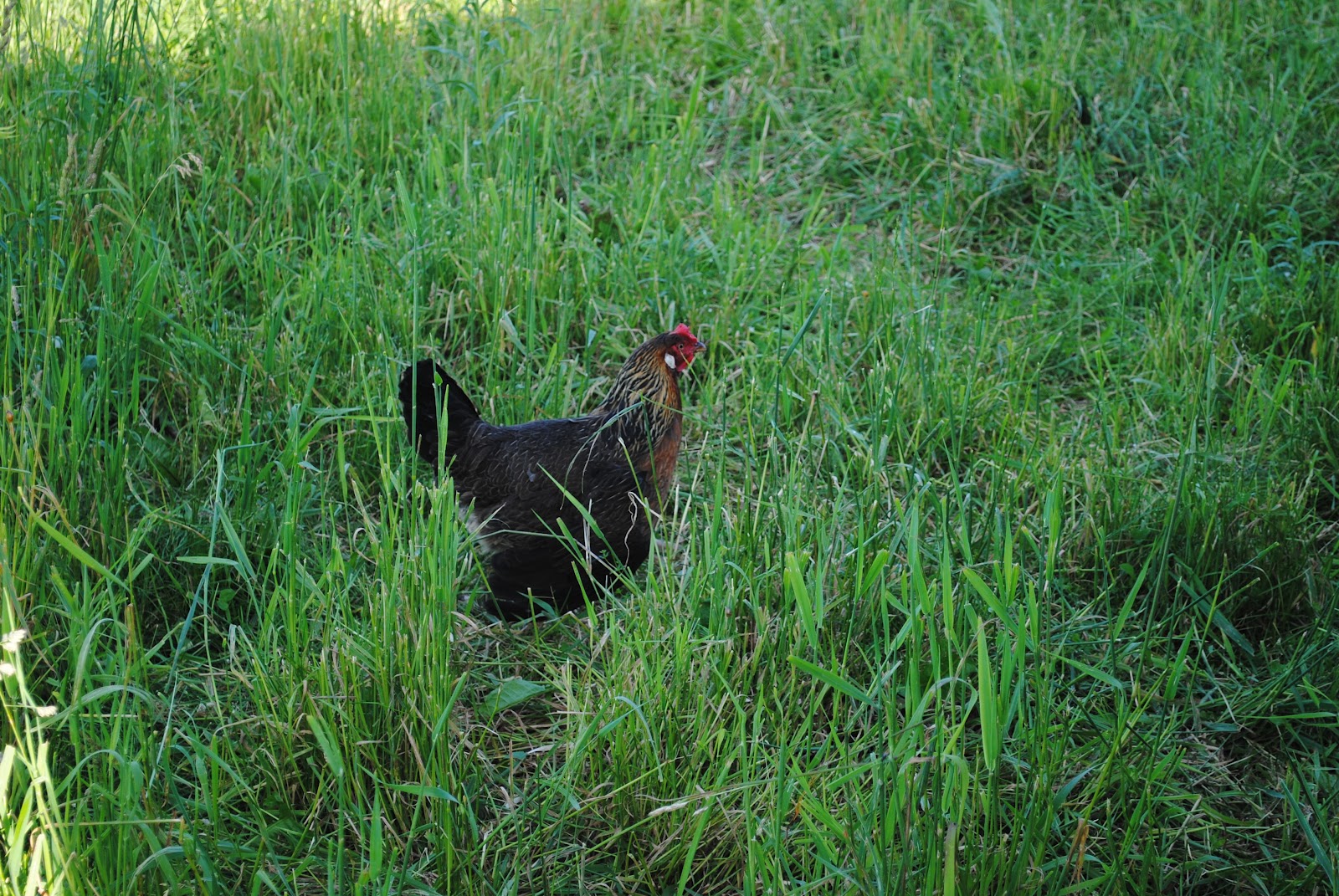
While many elements on the farm are working together seamlessly, so seamlessly that we don't even notice them or call them to mind, there are a few exceptions. For one, this chicken is mysteriously crippled. One evening she didn't put herself into the egg mobile with the rest of the flock and was walking in a daze with her wings dragging on the ground. The next evening we found her lying on her back with her feet in the air. I thought she was dead until I noticed her breathing and saw that her eyes were still alert. Edmund righted her and she got up and walked away from us. I expected to find her dead the following day, but instead found her as you see her above - with her right wing hanging limp and the left one not far behind. I've opened a few books and mentioned it to a neighbor, but there are at this point no firm leads as to what could be going on with her. If you've seen it happen to one of your hens, tell us about it.


The other unfortunate event was that we had two calves born on the same day, to two different cows, but one of them was born dead. No one witnessed the event, but Ed found Juno standing over her dead calf very shortly afterwards. It was a bull calf and he was quite large - larger than the calves that were born weeks ago. That's the only thing that stands out as a possible cause for complications. It's very sad to have a year of energy and effort go into something that is not to be. Thankfully the other calf is a heifer. It would have been extra sad if it had been the other way around. But we are sad nonetheless.


Aside from that, the geese are growing well, the grass is as tall as the weeds, and the days are still getting longer.


-Alanna