Tuesday, September 24, 2013

Grass-fed and Finished

This week we get to go to the fun stuff.
I arrived early enough to catch them in bed! One year old steer in the foreground.  This year's calf, a cow, and our bull, Mr. Winchester in are in the back.

Grass-fed meat is all the rage right now, and for good reason.  I read recently the grass-fed segment of the beef market is booming while the rest of the beef market stagnates.  The authors of the article attribute the consumer popularity of grass-fed to concerns about the wholesomeness of the meat fed in big feedlots, as well as for animal welfare and the environment.  I believe in my heart of hearts that grass-fed meat can be the best on all fronts - healthy meat, contented animals, and more fertile soils.  But as with grain finishing, just because something can be a certain way doesn't mean it is that way all the time.

The term grass-fed encompasses a huge spread of management intensivities.  Some producers put a perimeter fence around a piece of land and turn the herd loose.  Some producers have a few large paddocks they slowly rotate the their cattle through every few months.  Others, like us, use both perimeter and portable electric fencing to allocate a small amount of pasture at a time and then move the herd onto fresh grass every day or so (see photos below).  Daily moving allows adequate rest periods for the grass to recover between grazing events, thus the more palatable species of plants are not munched to death by hovering grazers.  It promotes taller and healthier pasture plants that can tap deeper nutrients in the sub-soil.  It supposedly sequesters carbon into the soil as organic matter much faster than say forests or ungrazed grass.  It keeps the herd clear of its own waste until enough time has elapsed for the manure to reincorporate into the soil.  It reduces erosion since the grass sward is denser and more vigorous, and there is no plowing for the finishing feeds.  It reduces the need for fossil fuels since growing grain requires a lot of diesel for tractors, combines, and trucks for hauling the harvest.

Frequent (more than once per week) moves generally allow for a higher average plane of nutrition in the paddocks the herd has access to every day.  Better nutrition allows cattle to express their genes fully and those that are suitable for grass finishing come to the fore.  Good genes under good management makes for exceptional meat.  Good genes under lax management e.g. turning the herd loose for the entire year in a single large pasture, does not.  Cattle unsuited to grass production will never grow great beef, even under the best management regime.  Management can help the marginally suitable animal achieve full health, and therefore be reasonably tasty on the table.

The take away lesson here is this - the term "grass-fed" does not guarantee a great steak.  In fact, there are plenty of average and even sub-par grass-fed products chasing the price premium it offers.  The best tasting is always grass-fed though, and when one factors in the social, environmental, and animal welfare components of grass vs grain it becomes a no brainer.

Grass farm pastures should not look like golf course fairways.  If they do the animals and the pasture are not going to express their full potential.  Depending on the time of year and most recent cut, hayfields can have a fairly uniform even appearance.

It is hard to judge distances in the photo, but this first image shows one day's worth of grazing.  Look closely and you can see white pigtail posts on both sides of the picture.  This is early morning and I've just moved the cattle into their fresh "break" of grass.  To the left of the herd you can see the effect that 24 hours of animal impact has on a patch of pasture.
The camera flattens the topography.  Here I'm looking up a moderately steep hill toward the cattle.

Getting closer, and a better look at the portable electric fence used to contain the cattle.


Here is another image of impact. We're looking at the ground in the area the animals just finished. Note the mat of grass pushed against the soil, this protects from erosion and feeds worms and microbes.

Here is pasture after roughly a week of regrowth.  That shaggy look is a good thing when it comes to pasture.


Finally, don't forget water.  We buried a line in this pasture and use gravity to pull water where we need it.  That's a 40 gallon plastic tank that is light enough for one person to move easily.

That's it for this week.  I have a little more to say about beef, but I'm going to wrap up in the next week or two.

-Edmund

Sunday, September 15, 2013

Grain Finishing


Last week we went through a sort of general overview of a steer's life.  This week we go into a little more detail about finishing on grain.

Grain finishing rations for steers are mostly corn and beans, but they include all kinds of other stuff too. I've seen footage of a feedlot mixing waste candy, wrappers and all, into a wagon to feed.  Until the mad-cow scare of the 90s it was legal to feed protein sources from slaughterhouses.  In some places it is still common to put chickenhouse waste (chicken poop) into cattle rations because the rumen bugs can use the nitrogen in it to make proteins.  Nevermind that a cow would never eat chickenshit given a choice in the matter, or the fact that it can impart a fecal smell to the carcass itself.  The bovine digestive system is a beautiful thing, designed to process large amounts of low quality feed into parts and pieces of life.  It is easily overwhelmed by concentrated sources of calories like corn and bean meal.  An out of whack digestive system pushes problems into the rest of the organism and they get really fat really quickly.  They're fed antibiotics and other growth promotants to push their growth rate up ever higher.  Most receive an ear implant of hormones to goose their growth beyond the pale.  All these things would be fatal in short order for even the most rugged steer, but the cattle go to slaughter before the wear and tear of pharmacology, unhygenic living conditions, and an unatural diet can exact their ultimate toll.

Most consumers only ever meet their meat on the dinner plate.  So what does grain finishing this way do to the final product?  It makes for a higher percentage of soft meat (this is the one desirable outcome of this style of finishing).  Standing around waiting to be fed doesn't promote connective tissue development the way walking a hill in search of a tasty bite of grass does.  This allows some cuts of a grain finished steer to be softer on average than a properly finished grass-fed beefer.  I'm thinking specifically of round and sirloin tip steaks...  But the classic steak cuts from the rib and loin should be tender, no matter the production model.  If they're not, something is out of whack.  Grain finishing changes the fat profile in the meat.   Grain finishing allows for slaughter at a younger age as we discussed previously.  I believe there is a rough correlation between age at slaughter and flavor.  All other things being equal younger animals are milder in the flavor department.  And many people are now used to bland beef because that's all they've ever been exposed to.  Grain based rations also dampen the flavor compared to the diverse diet of self-fed cow.  Our pasture has at least 70 species of plants, and the cattle eat most of them.  On a mixed ration cattle get all their sustenance from just a few plant seeds, and the majority of it is corn.

Most grain finishing occurs on huge, huge feed lots in the mid-west.  These massive manure factories foist their odors and water contamination on all the neighbors within several miles, but just because most operations move with disregard for the social and environmental externalities they impose on their communities doesn't mean grain finishing must be that way.  There are smaller organic feedlots that do a much better job of keeping their animals healthy and clean.  And there are many small farms like ours that have a beef herd and sell meat directly to consumers after finishing the cattle on grain themselves.  So if you prefer the flavor and texture of grain finished beef, it is possible to find farmers who do it as well as it can be done.

Next week we get to the fun stuff that really makes us different - grass finishing.

We don't feed our cattle any grain so I can't show a picture of it, but since photos are fun here's one with some cows and two calves from this year.


-Edmund


Tuesday, September 3, 2013

Cairncrest Beef II


Last week I covered some basic definitions of terms I will use here and there in the coming posts. Now I get to go into actual production descriptions.

Most beef calves are born in the spring or late winter.  They spend the first six or eight months of life at momma's side, typically on pasture.  Once the farmer or rancher decides it's time to sell the calves they get sorted off their dams and sent to auction, or if they're lucky, straight over to a "stocker operation".  Stocker operations are typically pasture-based, but many use supplements (grain) to make cattle grow faster.  The stocker raises the steers and heifers up to "finishing size", at which point they're loaded into a truck again and shipped to a feedlot.  They then stand around eating out of troughs and standing in their own waste for approximately four months, though it can be as short as one month or as long as six. Once they're "finished" they truck one more time to a large slaughter house where they're killed and butchered. Total time from elapsed from birth to death is somewhere in the neighborhood of 18 months.


At our farm calves are born in the spring once the chance of snow is low.  They run with their dams on the pasture until the fall or late fall when we wean them across a few strands of electric fence.  The calves spend the winter in a bedded barn with access to the outdoors.  In the spring they rejoin the cowherd and run together for the entire next year.  They go through their second fall and winter as part of the larger herd eating dormant pasture and hay we provide.  They shelter from our nasty winter winds behind the tree lines and topography of our place.  When the warmth arrives again they fatten up on the high quality grass that flushes out in spring.  Then they have one short 20 minute truck ride to the slaughterhouse where they're dispatched quickly.  Total time from birth to death is 24-30 months, or even longer in some cases.

There are a number of points here that ought to be addressed.  One is the number of times the animals are trucked around.  Shipping is extremely stressful to cattle.  They often get sick immediately after being shipped because of the stress involved.  "Humanely" raised meat does not include number of times a given animal is shipped during its life, but in my book it ought to be one of the many metrics used to determine whether a cow was in fact raised ethically.


The time discrepancy between the two models is important from a cost perspective.  The longer life of a grass-fed animal means we need to feed it for more days.  That increases our costs, and thus the price of the final product is higher too.

Also notable is the fact that even in this day and age, the realities of the bovine life-cycle do not lend themselves to mega-agri-business for the first 2/3 of a cow's life.  Pigs and chickens have been relegated to vertically integrated CAFOs (concentrated animal feeding operation) for several decades thanks to the American dictate that food must be cheaper at any cost.  The logistics of trying to deal with the health of a confinement operation for pregnant cows appears to be beyond the ken of even IBP and Cargill.  "Conventional" beef cattle still get to spend a little over a year in the wide world of grass and sunshine.  So its really the finishing period that sets beef into different worlds.

- Edmund


Wednesday, August 21, 2013

Cairncrest Beef I


I  imagine our customers are aware of the many differences between our 100% grass-fed beef and that offered in the supermarket.  They're both "beef" but they could be from different species if one judged solely by qualitative factors like flavor, odor, color, and texture.  We've all seen the photos of mega feedlots where cattle stand hock deep in their own excrement for the few months leading up to slaughter, and that is certainly the most glaring point of diversion, but there are several others worth noting as well.  Because I find the topic very interesting,  I'm going to do a series of posts about beef in general and particular.  Here's the first installment.

I'll start with some definitions so we're all basically on the same page when I get into the meat of my essay here.

Management - When I use this word in relation to farming and livestock I'm approaching it from the perspective of Allen Savory as described in his book Holistic Management.  If his book could be distilled into a few words it would say something to the effect that everything we do or choose not to do is a management decision.  Decisions are linked together and we need to look at the big picture and ask ourselves whether a little choice we're making right now in any given moment is taking us toward our goal or away from it.  And we need to ask whether the action we're taking is the best action to take.  Is there something else we could do at the present moment that would get us closer to the big picture more quickly than whatever it is that is at hand?  This will become more concrete later when I get into management intensiveness.

Grass-fed - Cattle eat grass.  They also eat a lot of other pasture plants like legumes, bedstraw, thistles, and burdock.  Our pastures include all of these and more.  When I say "grass-fed" I mean they eat exclusively from the pasture during the grazing season (grazing season doesn't perfectly overlap with the growing season), and stored hay during the winter.

Grain - Seeds of plants in the grass family - corn, wheat, barely, etc, harvested and concentrated by human ingenuity.  I'm not referring to the incidental grass seed the cattle eat when a pasture sward gets a little mature and sets seed.

Finishing - The window of time immediately prior to slaughter.  Fattening occurs during the finishing period. Finishing is critical for proper flavor development and cooking properties.  Without adequate "finish" steaks are lean and prone to drying out while cooking.  Some cuts are this way no matter how well finished the animal - sirloin tip, flank, and round steaks for example, and must be cooked on the rare end to retain any juiciness.

More next week!

-Edmund


Thursday, July 11, 2013

Beef for sale


Soon, August 3rd to be precise, we will have our 100% grass-fed and finished beef for sale.  Our cattle live outside year-round and they eat only pasture plants and hay, never high energy supplements like grain or beans.  Every day during the grazing season (April-mid December in our area) they get a fresh patch of grass to eat and bed on.  During the winter they escape the cold wind by snugging up to the tree line and we supply hay.  

We're proud of our animals and our production methods.  Raising animals the way we do provides them with the space to fulfill their instinctive drives, minimizes the fear they experience during their lives, and as an added bonus it improves the fertility of our soils.  When we get to provide our hard-won meat to our customers it is gratifying to feel like we've engaged in a win-win-win exchange.  Our customers get clean healthy food, we get enough money to encourage us to keep at it, and our land creeps into greater productivity and fertility.

Perhaps most important of all, the flavor of meat raised on pasture is unbeatable.  

Pricing 

Ground Beef/Stew Meat   7.00/lb
    15#                             6.25/lb
    50#                             5.50/lb
Chuck (pot) Roast            7.00/lb
Loin Steaks                    14.00/lb
Filet Mignon                    20.00/lb
Rib                                 14.00/lb
Shanks                           5.00/lb (significant amount of bone)
Sirloin Steaks                  12.00/lb
Round Steaks/Roasts       10.00/lb
Flank Steaks                   10.00/lb
Tongue                            3.00/lb (fantastic lunch meat cold cut, but takes a little work to prepare, ask me how)
Liver                                2.00/lb (these are mature animals, strong liver flavor, dogs love it though)
Heart                               5.00/lb
Suet                                1.00/lb (good for cooking and bird food)
Soup Bones                      0.50/lb


If anyone has questions we're happy to answer them.  We have a few go-to recipes for cheaper cuts if needed too... Shanks are one of my favorite cuts for example, just ask... cairncrestfarm@gmail.com is the best place to  direct orders and questions.


  -Edmund

Wednesday, June 5, 2013

Heritage Turkeys

The turkeys arrived on the 25th of April with a note from the hatchery telling us that they would be 'lively, husky and' some other adjective that has since been forgotten because the word husky was so preoccupying. Husky? At any rate, three of the 21 perished within a day or so of getting here, which is on par with other poultry we've raised. 


It seems that the world is full of conflicting reports about turkeys and their ability to survive even the simplest events in life. For instance, after praising their stamina, the hatchery insisted that baby turkeys never be let out in the rain and that they even prevent their mature birds from getting wet throughout their adulthood. What? We'll need to be hustling turkeys in from the pasture when a cloud blows over? Garth read that Joel Salatin doesn't shelter his turkeys from weather events at all, while I hear people locally tell us about turkeys that stand in the rain with their heads up and drown.


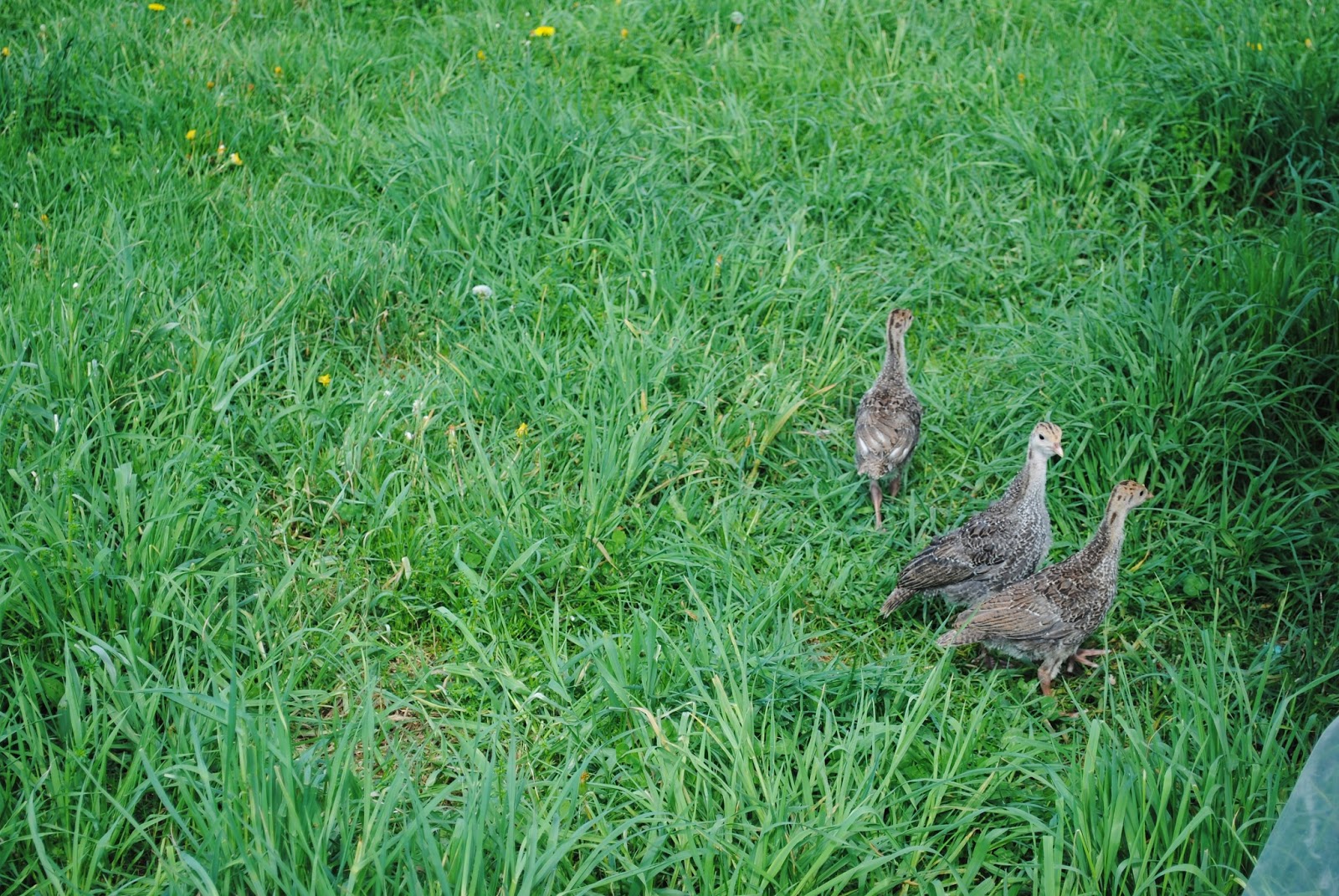
Well, so far they have been much more sophisticated than we feared. We began letting them out to range around a week or two ago. There have been a couple fast moving storms that worried me, but the birds have put themselves inside or under burdock leaves and have suffered no harm. Their personalities are fairly ideal. They are curious, friendly, and seem to be free of the constant stress and terror that consume chickens from the inside out. They love being in the grass and they make a wide variety of calls to each other, none of which affront the ears the way a goose or a hen call might. They are lovely. They are almost big enough now that stray cats or clever skunks have ceased to pose a mortal threat. With a little care they should continue to flourish from here on out.


- Alanna

Wednesday, April 10, 2013

First Calf of the Year

Robinia just gave birth to a beautiful heifer calf on the 8th. It was the first day this spring to reach 60 degrees, and the cows were panting and desperate in their winter coats. They'd had reason to keep them until now.


Robinia is the first cow born on our farm to give birth on our farm, which feels like a landmark. So, let the calving season begin! And let the shedding season commence soon too!

- Alanna