Sunday, July 11, 2010

Parsnip Pox


Though as a child I did suffer from the idiosyncrasies of taste common to most of us in our formative years - mushrooms, of course, offended my palate, as did most fruits for textural reasons (a crisp, ripe apple being the exception) - I nevertheless loved vegetables. I recall reading a study few years back which determined that children who prefer salty snacks such as pretzels to sweet snacks like cookies are more amenable to the idea of eating vegetables but less likely to eat fruits than peers who reach for the Oreos, this latter group showing the opposite preference, and my tastes largely supported this finding. Given my current dietary view, I would now question these stark categories of salty and sweet and thus the study itself, since the sugars in pretzels are only marginally less refined than those in cookies. Anyhow, what I am working around to is that, whatever the underlying cause and whatever the relationship between my real food and junk food preferences, I have always liked parsnips.

In the produce aisle parsnips look like beige carrots. Like carrots they are beinnial, meaning in the first year of life they have a relatively innocuous growth habit, and all surplus energy is used to create a large taproot. This taproot, harvested after sufficient growth in the first year, is the form in which they are most commonly eaten. If allowed to remain in the ground, or, in the case of more tender varietals in harsher climates, assisted by various means I won't detail, in the second year the plant will bolt a towering flower stock, set seed, and die in the fall.


Alanna and I first noticed parsnips after the snow had melted, when we kept stubbing our toes on their tops in the area beside the hops barn. They were shouldering up out of the ground as dense as checkers on a checkerboard. Wild parsnips, unlike wild carrots, are virtually indistinguishable from their domestic counterparts, meaning we could have dug these up and roasted them, which, as previously established, I would have enjoyed. But we had not seen the leaves or flowers of the plants and thus were put off by the admittedly slight chance that the tubers were actually poison hemlock, though this fear has been validated to some extent by a few instances of this plant further upstream. (This is not related to the hemlock tree, of which we have many. The plant that poisoned Socrates resembles a parsnip in its odor, roots and leaves, but less in its flowers.)

As spring progressed into summer the parsnips grew stalks topped with yellow bursts of tiny flowers, some seven feet tall. In addition to the large stand next to the hops barn, numerous individuals and groups shot up on the fringes of the driveway, throughout the pastures, and in a near continuous band around the perimeter of the large barn.

When I was learning to distinguish the parsnip from its deadly doppelganger I learned much about it, but the most common point of interest was that the sap from the vegetative portions of a parsnip can cause phytophotodermatitis, meaning that when sunlight hits an area of skin that has the sap on it, holy hell breaks out.


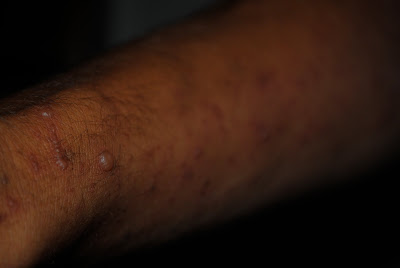


So it was idiocy unmitigated even by ignorance when I went after it with a weedwacker a few days ago and thought nothing of the plant matter sprayed up and down my arms. The blisters should subside quickly, but the discoloration could last for months or longer.

-Garth


Wednesday, July 7, 2010

Broken News?


We have been so busy here-dawn until dusk, and then a little more for good measure. That is all well and good but it means that the latest breaking news on the farm doesn't get to you until it is, broken? House broken? At any rate, here are some highlights.

Silo, your days here are numbered. That's right folks! Someone wants our silo. Not only are they going to come and take it down, concrete stave by concrete stave, they are going to pay us for the privilege. We couldn't be happier. The man taking it down will most likely sell it to someone who wants a silo. That person will theoretically get a good deal. The guy removing it for us will make a little money selling it. The silo will be repurposed and we won't be living its shadow.


Wild strawberries. You heard it from my full mouth. Edmund and Normandy went picking wild strawberries and black raspberries that have cultivated themselves in secret on our farm. They are so delicate.

I am not sure that wild strawberries ought follow silo removal in order of importance, but I guess it's a testament to how broken this news is. There is still more to tell but I have to sleep before tomorrow starts.

-Alanna

Monday, June 28, 2010

Grateful harvest


These are the first fruits of our garden. It was all the snails and slugs felt they could spare. They are less sweet than many sugar snap peas I have had. I am not sure why. Thankfully, they are not lacking in snap.

-Alanna

Saturday, June 26, 2010

We've been outnumbered


Three bull calves drinking milk from this 'New Zealand style' calf nurser

Dusty on a dewey morning


Ned


I guess when I say 'we' I am referring to the three female cows, Normandy and myself. Let me explain. We initially bought three Kerry cows. Shortly thereafter we purchased three bull calves. So, at that time, there were three bull calves, three cows, two wives and two husbands; a gender neutral farm give or take a few chickens. Two of those three cows were pregnant. That was the wild card. There was a 50% chance that we would remain in balance. Juno had a bull calf on June 19th leaving it for Sable to decide. Today Garth and Edmund came in from feeding the cows and announced that Sable had calved early this morning. "A heifer?" I asked. "No, a bull calf."


It is an overcast afternoon. The clouds carry on in an apathetic way, as though they forget they're raining, but it's too late to stop. Garth and I walked to the barn where the cows were all gathered. Lucky and Dusty were lying together at the open door (we named the three bull calves after the 'Three Amigos': Lucky Day, Ned Nederlander, and Dusty Bottoms). The two nursing mothers lay with their calves. The newest one (still yet un-named) has the intense and stricken look that comes with being born. The whites of his eyes are still visible. He is as tall as 'Borg' at the hip despite being a week his junior. His legs are long and gangly. There were a few chickens making their way along the edge of the barn and he stood up and stumbled over to them, inadvertently chasing them away. He has a couple of white spots here and there, a testament to the vast genetic possibilities latent within even something as carefully managed as a cow with a pedigree. If we decide to raise one of them as a bull, it looks from here like 'Borg' is the better candidate. He is entirely black and compactly built, but there is much to be seen.


While two heifers would have been quite fancy, and one out of two would have been grand, I am not discontent with our lot. How could I be, when the dams are so well and their calves are beside them?


-Alanna

Tuesday, June 22, 2010

Borg is Born


On the morning of June 19th, we awoke to find a new member to our herd! We named our new bull calf Borg as a nod to the 18th century philosopher and theologian, Swedenborg. Every dairy farmer hopes for a heifer (female) calf which would become a future milker, so we were a little disappointed with a bull calf, but it was exciting to have a new addition regardless. Borg's mother, Juno, has been very protective of him, and will paw at the ground in warning if she feels we are getting too close. If anyone has seen the high-spirited energy of puppies, they will recognize the same playfulness in a baby cow.
Here is a picture of Juno and Borg. These black cows in a dark barn have been hard to photograph, but I think this image captures them adequately.

Normandy

Friday, June 18, 2010

The slugs are winning...


In March, when we were making soil blocks and planting seeds I had a fantasy of harvesting vegetables from our garden for our table. I did not picture a thriving population of slugs and snails enjoying them first. They seem to prefer the brassicas (kale, cabbage, kohlrabi, broccoli) but they are gaining on the potatoes and the rhubarb. This region, like many areas on the East coast, suffered a tremendously damp and cool summer last year which may have given the slugs a leg up (they need one! HA!). But this could also be par for the course around here. I just don't know. My only recourse is to head up the to the garden in the evening with 2 cans of 'natty ice' and begin pouring.


I have placed bowls on several of the beds they like to congregate in. Crouched near the ground with wafts of cheap beer surrounding me, childhood memories of late night wedding receptions and big hair flood in. I leave these bowls of beer out overnight and come back the next day, horrified and amazed by the abundance of creation.


This photo, as impressive as it is, is a week into this routine. The first night I did this the bowl was full, FULL with a crusty top, of slugs. I take them down to the chickens who, after walking over and through them a few times, gorge themselves. If I eat an egg from a hen who ate slugs, who ate the kohlrabi I planted, I am still 'harvesting' from my garden by a circuitous path. So I suppose right now the slugs are winning in the timeline, but ultimately we can't lose.

If anyone has experience with vast numbers of ravenous slugs and snails and has had success by a different method, please fill me in. I do like vegetables.

-Alanna

Monday, June 7, 2010

Wildflowers


A series of drenching rains came after some weeks without any water to speak of and now a cooler period has just set in. The ground is finally fully saturated. I am thinking about planting radishes again and feeling relief about having just planted out our red russian kale seedlings before the weekend. The nights are in the 40's and it looks like it may stay this way for the next few days at least.

Granted I am new to this part of the world, but I am floored by the wildflower display here. We (Edmund) ha(s)ve been regularly mowing a small area around the house, (think of a bow tie around a large man's neck), and a walking path to get to the chickens beyond. We have otherwise let these meadows run their course. Walking through the knee high forage I let my eyes follow the colors below me. So many things are simultaneously in bloom, yet they manage to graciously share the spotlight. A week and a half ago I saw whole fields in bright pink. It was close to a bubble gum color, but there was a rich magenta in there somewhere. This pink was set off by stands of buttercups screaming just beside it. Today the roadsides were dotted with periwinkle bobbles on strong stems. Our stream bank has put on a floral skirt, thick with blue blossoms. The bishop's weed is endearing itself to me now after months of looking like the greedy and thoughtless intruder it has in other seasons. The peppermint is hugging the sides of the stream and was bountiful enough to yield a basketful to me this evening. For the best tea imaginable, I am following Dorothy's guidance; keeping the harvested leaves away from the sun and turning them regularly until they have dried. When we make this tea some evening months from now, I hope I can recall this subtly opulent spectacle. My heart goes out to all the people in the gulf who are experiencing a gross inversion of what I have described here. Today I am not sure how I would survive without petroleum, but this disaster is urging me to move in that direction. I know the stream bank would not be phased. We could start there.

-Alanna