Tuesday, June 19, 2012
"If you're going to have livestock, you are going to have deadstock."
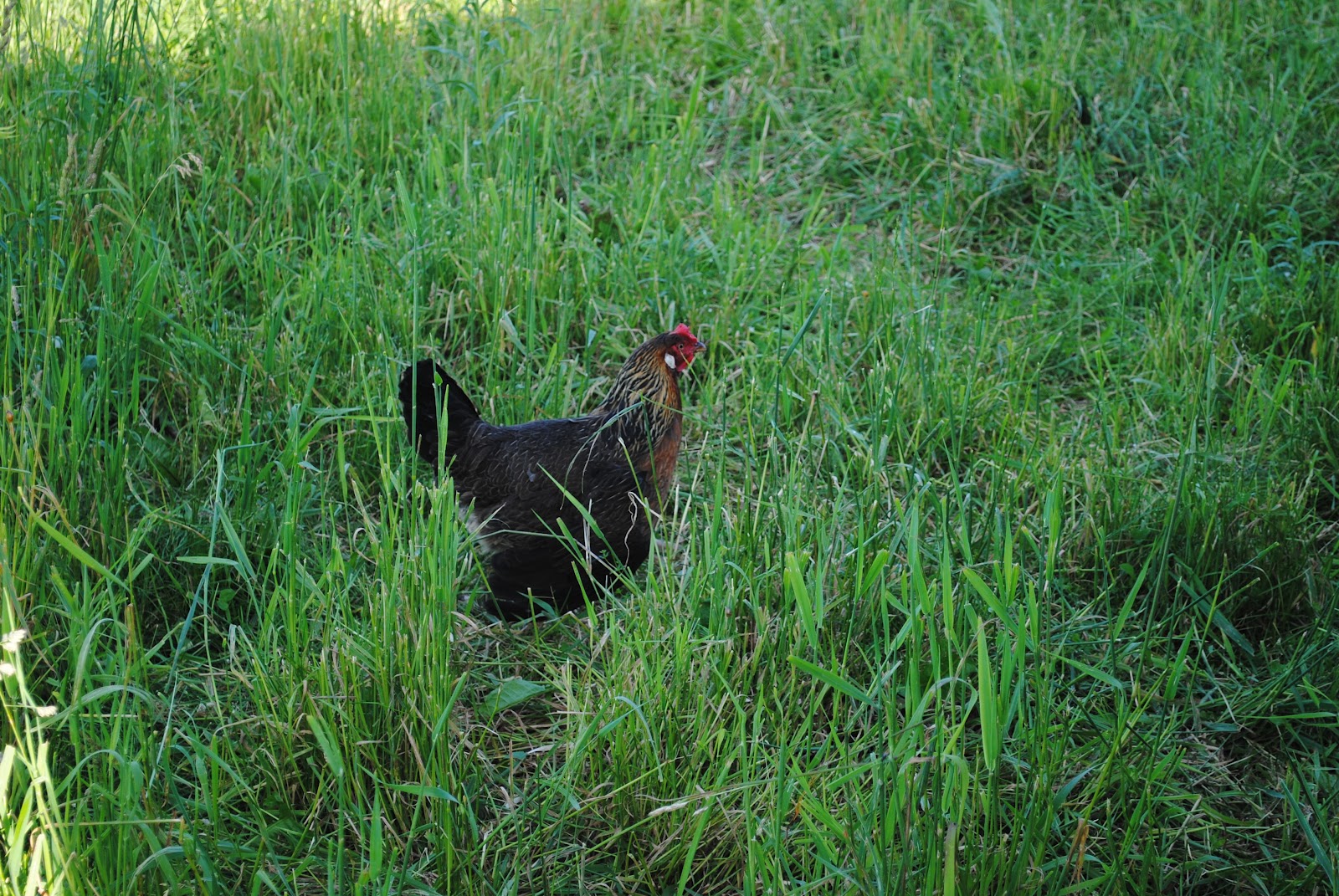
While many elements on the farm are working together seamlessly, so seamlessly that we don't even notice them or call them to mind, there are a few exceptions. For one, this chicken is mysteriously crippled. One evening she didn't put herself into the egg mobile with the rest of the flock and was walking in a daze with her wings dragging on the ground. The next evening we found her lying on her back with her feet in the air. I thought she was dead until I noticed her breathing and saw that her eyes were still alert. Edmund righted her and she got up and walked away from us. I expected to find her dead the following day, but instead found her as you see her above - with her right wing hanging limp and the left one not far behind. I've opened a few books and mentioned it to a neighbor, but there are at this point no firm leads as to what could be going on with her. If you've seen it happen to one of your hens, tell us about it.
The other unfortunate event was that we had two calves born on the same day, to two different cows, but one of them was born dead. No one witnessed the event, but Ed found Juno standing over her dead calf very shortly afterwards. It was a bull calf and he was quite large - larger than the calves that were born weeks ago. That's the only thing that stands out as a possible cause for complications. It's very sad to have a year of energy and effort go into something that is not to be. Thankfully the other calf is a heifer. It would have been extra sad if it had been the other way around. But we are sad nonetheless.
Aside from that, the geese are growing well, the grass is as tall as the weeds, and the days are still getting longer.
-Alanna
Thursday, June 7, 2012
Suckling at Big Government's Teat
If you frequent our blog you may remember that last year we had several incredible rainfalls that flooded our little gully and eroded many cubic yards of our farm. I don't know whether the torrents that affected our region of upstate played a role in the county Soil and Water Conservation Service securing grants for stream bank stabilization, or whether these things just "come through" periodically.
I do know that last winter Alanna caught wind of the possibility of said grant and added our names to the list of potential projects should the money arrive. Well, arrive it did, in the form of a crew of guys with weed whackers, landscape fabric, plastic mesh tubes, stakes, and most importantly, tiny trees. They spent three days working along the 1/3 mile of creek and planted willows, poplars, red maples, red osier dogwoods - 600+ trees at the final count.
I wonder several things about our new trees. What kind of mortality will see in the new plantation? Why did they plant them 8 feet back from the bank when the idea is to "stabilize the stream bank"? Will they come back and weed whack the grass around the saplings next year (just kidding I know they won't)?
So next time you feel the inclination to complain about the use and distribution of your tax dollars you can think of us because we just received a smidgen of a cent from you and every other American. I see the potential benefit of riparian tree planting as benefiting everyone downstream of us, so I don't have compunctions about being on the receiving end of this project. Your tax dollars at work!
-Edmund
Friday, May 18, 2012
Very Grown Up Geese
This is neither here, nor there, but the voracious groundhog that lives beneath our back porch is exhibiting a startling tail that I thought you might want to see. This picture was taken from our dining room table, so it doesn't have quite the same impact that seeing the tail outstretched behind the fleshy beast, just feet away from you, would. At any rate, the tail looks like a rigid, shaven pole that bursts into a pom pom of fur at the very tip. I guess the rats have been grooming him while he sleeps.
The real reason for me writing is that our geese had their first grown up day today. We let them out of of the hoop house to graze on their own. They kept so close to each other that it was as though they were one animal. They are totally adorable. When I first went out to check on them after about four hours I couldn't find them anywhere. That was worrying. A few more anxious minutes passed before I saw them clustered in the shade. They graze the way cows wish they could. They take a few steps and then land on their bellies, nipping the ends of everything they can reach easily before getting up to waddle a few steps farther.
Although they are predominantly sweet and submissive now, their goosely powers have already become evident. Garth said that this morning he watched them intimidate a chicken that had come by to examine them. They stuck their heads out and extended their necks like upturned cannons ready to fire. The chicken, though twice the size of one of them, was scared away quickly.
Will they always move like one animal? Will they rule over the chickens on day? If they do, will they stop there? I don't want to be subservient to another goose. It's happened before and it's unpleasant. At least for now, they are just adorable.
-Alanna
Friday, May 4, 2012
Chicks and Goslings
Our goslings came this week. They were meant to ship two weeks ago, but the hatchery had an under-hatch and couldn't send them until now.
This is our first time raising geese. They are so different than chickens. First of all, they are not frantically afraid all the time. They are goofy and clumsy on their feet. I often see them trying to do something and 'oops!' roll over themselves. This is true despite their being very rugged and hardy. They are ecstatic about eating grass. When I reach my arm down to do something in their brooder they waddle over to my hand, unlike the Black Australorp chicks next door that fly into a panic and huddle together in the corner, leap frogging over each other to get as far away from me as they can. The unfortunate confession I have to make is that I cut one of the gosling's beaks by accident yesterday. I was cutting up some grass into small pieces, and one of them was so eager that it went in for the blade I was cutting right then, putting its beak between the shears. It was so sad. It bled, but that seemed to be the worst of it.
We read that if you become bonded with geese when they are young they may see you as a threat to their authority in older age and be more aggressive towards you in time. It's similar to raising bulls. The ones that stay under their mothers and are not cared for exclusively by humans are less likely to challenge humans later when they are vying for dominance. This challenges all that I've heard about the mutual affection between people and geese. Whatever the case, if what we read is so, it seems like it's going to be very hard not to become fast friends with them.
-Alanna
Monday, April 23, 2012
The Ethics of Eating Meat
The New York Times recently ran an essay contest on "the ethics of eating meat", and the six winning entries were just published. They can be read here. Both Garth and I entered the contest, though neither of our essays were published by the Times, but since I have a platform here I thought I'd share it with all you dear readers.
Small disclaimer - there was a 600 word limit, and that is the primary reason for such a string of statements without further explanation about the reasons I hold the beliefs I do. Anyway, here it is.
Human history is inextricably linked with the consumption of other animals. Building and fueling large brains required the concentrated source of calories that meat and offal provide. Thousands of generations of meat eating shaped our guts and metabolisms to be optimally healthy with flesh as a component of our diet, and all the vegetarian beliefs I used to propound cannot change this simple fact.
- Edmund
Small disclaimer - there was a 600 word limit, and that is the primary reason for such a string of statements without further explanation about the reasons I hold the beliefs I do. Anyway, here it is.
My belief that eating meat is ethical is informed by several concepts I hold about the world, namely, that humans are a part of the world and dependent upon it, that human choices affect the natural world for better or for worse, and that partnering with animals under a rubric of wholisitic management is the best way to achieve maximum health for livestock, humans, and the environment we share.
By no means are all steaks morally equivalent, and certain parameters must be met for eating flesh to be acceptable. The animal that makes up my meal must have lead a life free of inescapable manure, pain or noise, and had little exposure to fear inducing structures or machines. Stated in a more positive manner, I eat animals whose living situations enabled expression of the full range of instincts and desires they were subject to in life. Most slaughter houses do not yet live up to this standard, but some do, and there is a nascent movement that is pressing for industry wide reform.
Bad range management is one of the greatest of humanity's failings. But improper application of grazers and wholesale disruption of ecosystems by poor grazing management in the past is not a reason to foreswear the many ecological benefits that can be gained from good pasture management. I take it as an unalloyed good that streams run clear and cool, the air smell clean, grass grow lustily and green, wild animals have space to meet their needs, that carbon is sequestered and soil made more fertile, and that we all - humans, domestic animals and wildlife, enjoy access to these environmental services. All of these goods can be affected for the better by grazers, increasing overall carrying capacity and thereby enabling more life, of many different forms, to live. Partnering with herd animals is the only way to achieve the high level of ecosystem vitality I currently see in a few small areas and easily envision on a much wider scale. To fully create this type of world requires that some of the herd be culled each year, and cycling their bodies into the larger whole makes more sense to me than composting them or feeding them exclusively to obligate carnivores like dogs or cats.
I eat meat because I see it as an integral piece of the larger puzzle we need so desperately to solve. Our healthcare crisis could be dramatically attenuated or even reversed by eating as our ancestors did. The potential reduction of morbidity and suffering is truly mind-boggling. Many of our ecological problems could be solved with the help of large herds of ruminants. The members of such herds can lead truly full lives where they find space and time to act on all their various drives. Cutting short the lives of some animals that the others in the herd, the range itself, and we humans can all achieve greater health is a difficult choice, but it is one that life demands.
- Edmund
Tuesday, April 17, 2012
First Calf of the Year
Thursday, April 5, 2012
End In Store
Garth has been attacking every perennial winter weed in the garden with a tool he recently found in the hops barn. It's like a one and a half inch wide knife crossed with a trowel that has one serrated edge on the left. It's entirely useful. I've been digging beds. The wind licks at my waist, scurrying up and under the bottom of my jacket.
It's too cold to plant anything now. Garth planted a variety of things during a week of fair weather that have all been killed or stopped dead in their tracks. We wait, and watch and make progress where we can.
-Alanna
Subscribe to:
Posts (Atom)